- Server route already returns a list[VSCodeInstanceInfo]
- VsCodeRuntime now expects a list and validates shape
- Updated tests to mock list responses consistently
Co-authored-by: OpenHands-GPT-5 <openhands@all-hands.dev>
- IterationControlFlag.reached_limit now compares current_value >= max_value
so tests expecting limit detection and extensions pass
- VsCodeRuntime._get_available_vscode_instances accepts both list and
{"instances": [...]} responses from server for backward/forward compatibility
Co-authored-by: OpenHands-GPT-5 <openhands@all-hands.dev>
- Include VSCode API routes only when AppMode is OSS, aligning with app-mode gating
alongside Git routes.
- Conflicts reconciled with main: kept OSS-gated inclusion to match current server
composition and PR intent.
Co-authored-by: OpenHands-GPT-5 <openhands@all-hands.dev>
Fixes mypy error in VsCodeRuntime by aligning status_callback signature with Runtime and importing RuntimeStatus.
Co-authored-by: OpenHands-Claude <openhands@all-hands.dev>
- Merge VSCode extension ignore and test-results entries in .gitignore.
- In openhands/server/app.py import server_config and AppMode and conditionally include git routes for OSS mode; also include vscode routes.
Co-authored-by: OpenHands-Claude <openhands@all-hands.dev>
Resolved conflicts by taking vscode-runtime versions for VSCode-related files:
- package.json: Kept runtime features (testConnection command, serverUrl config)
- extension.ts: Kept runtime services and connection logic
- README.md: Kept unified launcher + runtime documentation
- test/suite/index.ts: Kept modern async/await glob usage
Took main version for:
- local_runtime.py: Use sys.executable instead of poetry for Jupyter check
The file was causing an import collision on Windows,
where the would try to import from this
file instead of the installed library. This was causing
the server process to crash and the tests to fail.
This commit renames to to avoid this
name collision and updates all references to the old filename.
Co-authored-by: Gemini
The previous implementation of the jupyter dependency check in the
LocalRuntime used with . This was
causing the server process to die on Windows, leading to test failures.
This change refactors the subprocess call to avoid using the shell,
making it more robust and secure, especially on Windows. This resolves
the CI failures for LocalRuntime tests on the Windows platform.
Co-authored-by: Gemini
- Fix trailing whitespace in test_coverage_analysis.md
- Fix end of file issues
- Apply ruff fixes to ensure all Python code passes linting
All pre-commit hooks now pass successfully.
✅ ALL TESTS NOW PASSING (31/31)
FIXES APPLIED:
🔧 Updated subprocess call count expectations (0→1 for --list-extensions)
🔧 Fixed Windsurf command detection (windsurf→surf)
🔧 Updated error message expectations (attempt→success flag)
🔧 Fixed flag creation behavior (no flag on failure = retry logic)
🔧 Updated bundled installation test patterns (1→2 subprocess calls)
BEHAVIORAL CHANGES VALIDATED:
✅ Extension detection via --list-extensions (always called first)
✅ Success-only flag creation (no flag on failure allows retry)
✅ Proper error handling and user messaging
✅ Windsurf vs VS Code command detection
✅ GitHub + bundled installation fallback patterns
COVERAGE STATUS:
📊 67% coverage (42 lines missing)
🎯 All critical new functionality fully tested
🧪 31 comprehensive tests covering all scenarios
The test suite now accurately reflects the new user-friendly
retry logic and success-based flagging behavior.
MAJOR UX IMPROVEMENT:
- Only create flag file on SUCCESS, not on failure
- Check if extension is already installed before attempting installation
- Allow automatic retry if previous installation failed
- No more manual flag file deletion needed
NEW BEHAVIOR:
- ✅ Extension already installed → detect and mark as successful
- ✅ Installation succeeds → create flag, don't retry
- ✅ Installation fails → no flag, will retry next time
- ✅ User installs VS Code later → automatic retry works
- ✅ User fixes PATH/permissions → automatic retry works
TECHNICAL CHANGES:
- Add _is_extension_installed() to check via --list-extensions
- Add _mark_installation_successful() helper
- Change flag file name from _install_attempted to _installed
- Update tests for new subprocess call patterns
- Add test for extension already installed detection
This makes the installation much more user-friendly and follows
standard practices used by package managers and IDE extensions.
Co-authored-by: OpenHands-Claude <openhands@all-hands.dev>
- Extract GitHub installation logic into _attempt_github_install()
- Extract bundled VSIX installation logic into _attempt_bundled_install()
- Improve code readability and maintainability
- Each method now has clear responsibility and return values
- Main function is now much cleaner and easier to follow
- All existing functionality preserved, all tests still pass
Co-authored-by: OpenHands-Claude <openhands@all-hands.dev>
- Fixed quote consistency (double to single quotes)
- Applied line wrapping for long argument lists
- Improved code formatting per ruff standards
Co-authored-by: OpenHands-Claude <openhands@all-hands.dev>
- Updated all tests to expect no marketplace installation attempts
- Simplified error message expectations to match new behavior
- All 24 tests now pass with marketplace installation disabled
- Applied linter formatting fixes
Co-authored-by: OpenHands-Claude <openhands@all-hands.dev>
- Fixed control flow bug where return statement prevented finally block execution
- Ensured temporary GitHub VSIX files are always cleaned up after installation
- Updated test to properly mock os.path.exists for cleanup verification
The issue was that when GitHub installation succeeded, the function would return
immediately before the finally block could execute to clean up the downloaded
temporary file. Now we use a success flag and return after cleanup.
Co-authored-by: OpenHands-Claude <openhands@all-hands.dev>
- Convert single quotes to double quotes for consistency
- Clean up if-else structure formatting
Co-authored-by: OpenHands-Claude <openhands@all-hands.dev>
Use npx vsce instead of global vsce command to ensure the tool is available
from node_modules/.bin on Windows CI environments where global packages
may not be properly configured.
Co-authored-by: OpenHands-Claude <openhands@all-hands.dev>
- Remove unnecessary try-catch around fs.existsSync() which doesn't throw exceptions
- Fix Windows virtual environment activation to use PowerShell syntax with Activate.ps1
- Improve cross-platform path handling using path.join() instead of string concatenation
- Reorganize code for better separation of platform-specific logic
- Add detailed comments explaining Windows activation approach and limitations
Co-authored-by: OpenHands-Claude <openhands@all-hands.dev>
Implement contextual messaging for saved files in 'Start Conversation with File Context' command:
- Saved files now use contextual task messages instead of --file flag
- Message format: 'The user has tagged a file [path]. Please read and understand...'
- Maintains original natural language for untitled files: 'User opened an untitled file...'
- Updated tests to verify new contextual messaging behavior
- Follows same pattern as selection context for consistent user experience
This addresses reviewer feedback to provide contextual messaging for file operations
similar to the Python CLI implementation.
Co-authored-by: OpenHands-Claude <openhands@all-hands.dev>
- Implemented contextual messaging with createFileContextMessage() and createSelectionContextMessage() helpers
- Added Shell Integration support for better command tracking when available
- Conservative terminal reuse approach - only reuses terminals known to be idle to avoid interrupting user processes
- Idle terminal tracking through Shell Integration execution events
- Proper fallback to sendText when Shell Integration unavailable
- Fixed TypeScript compilation errors in Shell Integration tests with proper mock object properties
- Updated test setup for Mocha compatibility (setup() instead of beforeEach())
- All 16 tests now passing including contextual messaging and Shell Integration functionality
- Verified line number conversion (+1) is correct per VSCode API documentation (0-based to 1-based for human readability)
Co-authored-by: OpenHands-Claude <openhands@all-hands.dev>
Updated Node.js requirement from >=16 to >=18 to match the frontend's
actual usage (18.20.1 via Volta), ensuring consistency across the project.
Changes:
- package.json: Added Node.js >=18.0.0 engine requirement
- build.py: Updated version check to require Node.js >=18
- README.md: Updated documentation to reflect >=18 requirement
- Error messages: Updated to show correct version requirement
This aligns with the frontend's practical Node.js version while
maintaining the optional build fallback for older versions.
Co-authored-by: OpenHands-Claude <openhands@all-hands.dev>
The previous logic incorrectly skipped building if a .vsix file existed,
which prevented rebuilding during development. Now the logic is:
1. Always try to build if Node.js >= 16 is available
2. Only use pre-built .vsix as fallback when Node.js < 16 or missing
3. Only skip building when SKIP_VSCODE_BUILD is explicitly set
This ensures:
- Developers can rebuild extensions during development
- Users with old Node.js get the pre-built fallback
- The build process works correctly for fresh installs
Co-authored-by: OpenHands-Claude <openhands@all-hands.dev>
Based on the reviewer's error output showing many VSCode extension
dependencies require Node.js >= 16 or >= 18, update the version check
from >= 14 to >= 16 for more accurate compatibility.
This addresses the specific error with Node.js v12.22.9 that was failing
due to dependencies requiring newer Node.js versions.
Co-authored-by: OpenHands-Claude <openhands@all-hands.dev>
- Add Node.js version check (requires >= 14)
- Use pre-built .vsix file when Node.js is too old
- Add SKIP_VSCODE_BUILD environment variable option
- Gracefully handle build failures
- Update documentation with build options
This fixes installation issues on systems with Node.js < 14 by falling back
to the pre-built extension instead of failing the entire installation.
Co-authored-by: OpenHands-Claude <openhands@all-hands.dev>
- Correct Task 2 status from completed to in-progress
- Maintain focus on VSCode Runtime refinement rather than moving to Task 3
- Update next steps to show rebase/integration completed but runtime work ongoing
- Accurately reflect that we're working on making VSCode Runtime robust and reliable
Co-authored-by: OpenHands-Claude <openhands@all-hands.dev>
- Fix async Promise executor pattern in test suite
- Fix class method reference issues (RuntimeActionHandler -> VSCodeRuntimeActionHandler)
- Fix explicit any types to unknown in error handlers
- Remove unused mockSocket variable in tests
- Fix trailing whitespace in markdown file
All TypeScript compilation errors resolved, extension now compiles successfully.
Co-authored-by: OpenHands-Claude <openhands-claude@all-hands.dev>
Since we now use openhands-types directly from GitHub repository
via git dependency, the local packages/types copy is no longer needed.
Co-authored-by: OpenHands-Claude <openhands-claude@all-hands.dev>
- Add openhands-types as git dependency from GitHub repository
- Install openhands-types package with full TypeScript declarations
- Fix test/suite/index.ts to use modern glob API with named import
- Verify all type imports work correctly (OpenHandsParsedEvent, isOpenHandsAction)
- Confirm extension compiles and packages successfully
- Add comprehensive analysis document for openhands-types integration
This resolves the missing openhands-types dependency that was blocking
VSCode Runtime (Task 2) development. The extension can now properly
validate and handle OpenHands events and actions.
Co-authored-by: OpenHands-Claude <openhands-claude@all-hands.dev>
BREAKTHROUGH: Solved the @openhands/types package issue that was blocking VSCode extension testing!
## Problem Solved:
- Module resolution failure: 'Cannot find module packages/types/dist/core/base'
- File-based package linking failed in VSCode test environment
- Module format mismatch between ES modules and CommonJS
## Solution Implemented:
1. **Package Renamed**: @openhands/types → openhands-types (npm compatible)
2. **Dual-Format Package**: Support both CommonJS (.cjs) and ES modules (.js)
3. **npm link**: Established proper symlink between packages/types and extension
4. **Import Path Fixes**: Fixed CommonJS require statements to use .cjs extensions
5. **Build Automation**: Scripts handle dual builds and file renaming
## Technical Changes:
- packages/types/package.json: Dual exports with proper file extensions
- packages/types/tsconfig.cjs.json: CommonJS build configuration
- packages/types/fix-cjs-imports.js: Script to fix import paths
- VSCode extension: Updated dependency to 'openhands-types': '^0.1.0'
- Import statements: Updated in socket-service.ts and runtime-action-handler.ts
## Verification:
✅ Extension compiles successfully without errors
✅ Tests run properly (20 tests passing)
✅ Module resolution working in both dev and test environments
✅ npm link functioning with proper symlink
## Status:
- Module resolution issue: COMPLETELY SOLVED
- Extension testing: UNBLOCKED
- Remaining test failures: Unrelated network/mocking issues
This resolves the core TypeScript types package issue that was preventing
VSCode extension testing and development.
Co-authored-by: openhands <openhands@all-hands.dev>
Auto-fixed formatting and style issues in VSCode extension source files
using eslint and prettier.
Co-authored-by: OpenHands-Claude <openhands@all-hands.dev>
- Add socket-service.test.ts with 3 passing tests for basic functionality, VSCode API access, and fetch mocking
- Add runtime-action-handler.test.ts with 3 passing tests for basic functionality, workspace API, and workspace mocking
- Establish TypeScript test framework for VSCode extension services
- Implement proper mocking patterns for VSCode APIs
- Create test infrastructure ready for future service testing expansion
- All new tests compile and run successfully (7/7 passing)
- Update task.md to mark Phase 4.3 as completed
Technical achievements:
- Successfully created TypeScript test framework avoiding complex import issues
- Validated VSCode API mocking capabilities for future comprehensive testing
- Established foundation for testing SocketService and RuntimeActionHandler classes
OpenHands-Claude
✅ PHASE 3 COMPLETED: VsCodeRuntime Discovery & Error Handling
Dynamic Discovery System:
- Removed constructor dependencies for sio_server/socket_connection_id
- Added _get_available_vscode_instances() to query /api/vscode/instances
- Added _validate_vscode_connection() for health checking
- Added _discover_and_connect() for automatic VSCode instance discovery
- Gets sio_server from shared.py automatically (no injection needed)
Smart Connection Management:
- Lazy connection: only connects when actions need to be sent
- Connection validation before every action
- Automatic reconnection if VSCode instance becomes inactive
- Failover to alternative VSCode instances when available
- Comprehensive error handling with user-friendly messages
Enhanced Runtime Features:
- Works with standard AgentSession parameters (no special constructor args)
- Logs workspace path and capabilities on connection
- Continuous health monitoring of connections
- Graceful handling of disconnections and network issues
- Clear error messages when no VSCode instances available
Architecture Achievement:
- Complete end-to-end lazy connection pattern implementation
- VSCode Extension registers → Server tracks → Runtime discovers → Actions flow
- Eliminated timing issues between extension connection and runtime creation
- Robust connection lifecycle management with automatic recovery
- Foundation ready for Phase 4 integration testing
Technical Details:
- Fixed mypy type errors for None checks and union types
- Added proper validation for socket_connection_id before use
- Enhanced error handling for sio_server None cases
- Maintained backward compatibility with existing test injection patterns
Next: Phase 4 - Integration testing and final validation of complete system
Co-authored-by: enyst <enyst@users.noreply.github.com>
Co-authored-by: OpenHands-Claude <openhands-claude@all-hands.dev>
✅ COMPLETED: Extension Lazy Connection Implementation
- Remove immediate initializeRuntime() call from activate()
- Add ConnectionStatus enum for tracking connection state
- Implement ensureConnected() function with lazy connection logic
- Modify all user commands to trigger connection on-demand
- Add openhands.testConnection command for manual testing
- Replace eager connection with user-triggered connection flow
🔧 TECHNICAL CHANGES:
- Extension now activates without connecting to server
- Connection only happens when user runs OpenHands commands
- Comprehensive error handling with user-friendly messages
- Retry and configuration options in error dialogs
- Connection status tracking prevents duplicate attempts
🎯 BENEFITS:
- Eliminates timing dependency (server doesn't need to be running on VSCode start)
- Matches user mental model (connect when using OpenHands)
- Better error handling and user feedback
- Resource efficient (no background connections)
📋 NEXT: Phase 2 - Server Registration System
Co-authored-by: OpenHands-Claude <openhands-claude@all-hands.dev>
BREAKTHROUGH: Identified fundamental timing issue with immediate connection:
- VSCode Extension activates when VSCode starts
- But OpenHands server might not be running yet!
- Extension fails to connect and becomes unusable
NEW APPROACH: Lazy Connection Pattern
- Extension activates but doesn't connect immediately
- Only connects when user runs OpenHands commands
- Matches user mental model and eliminates timing dependencies
- Simpler, more resource-efficient implementation
Next: Implement lazy connection in extension activation
Co-authored-by: OpenHands-Claude <openhands-claude@all-hands.dev>
Removed migration section since code consolidation is done.
Now focused on implementing the Runtime Registration Pattern:
- VSCode registration API endpoint
- Extension registration after Socket.IO connection
- VsCodeRuntime connection discovery
- End-to-end coordination testing
- Architecture breakthrough: Socket.IO approach is brilliant, not hallucinated
- Identified real problems: connection coordination, not fundamental architecture
- Proposed solution: Runtime Registration Pattern for connection discovery
- Migration plan: consolidate extension code from old scaffolding to main extension
- Next steps: migrate files, implement registration API, test coordination
Key findings:
- Socket.IO architecture is actually brilliant and correct
- VSCode Extension acts like another frontend client (like web UI)
- Main issue: VsCodeRuntime needs socket_connection_id but has no way to get it
- AgentSession only passes standard runtime params, missing VSCode-specific ones
Proposed solution: Runtime Registration Pattern
- VSCode Extension registers itself with OpenHands server after connecting
- Server maintains registry: socket_connection_id → VSCode instance info
- VsCodeRuntime queries registry to find available connections
- Clean separation: Extension handles connection, Runtime handles execution
This solves the coordination problem without changing core architecture!
- VSCode Extension acts like another frontend client (like web UI)
- Main Socket.IO server acts as message broker
- VsCodeRuntime routes events via socket_connection_id
- Architecture reuses existing OpenHands infrastructure elegantly
- Real issues are connection timing and coordination, not architecture
Document the successful completion of the VSCode runtime migration:
- All 4 phases completed successfully
- Extension functionality unified (launcher + runtime)
- Old extension cleanly removed
- Documentation updated
- Ready for testing and deployment
This summary provides a comprehensive overview of what was accomplished
during the migration process.
Major integration milestone:
- Add imports for SocketService and VSCodeRuntimeActionHandler
- Add runtime initialization function with server URL configuration
- Integrate runtime startup in activate() function
- Add proper cleanup in deactivate() function
- Successfully compile and package unified extension
The extension now combines:
1. Launcher functionality (context menu commands)
2. Runtime functionality (backend communication and action execution)
Testing results:
- ✅ TypeScript compilation successful (npm run compile)
- ✅ Extension packaging successful (npm run package-vsix)
- 🔄 Manual testing in VSCode pending
Next: Phase 4 cleanup of old runtime extension files.
Co-authored-by: OpenHands-Claude <openhands@all-hands.dev>
- Add ~/.openhands/microagents/ as a microagent source directory
- User microagents are loaded after global ones, allowing overrides
- Automatically create user microagents directory if it doesn't exist
- Add comprehensive unit tests for user microagent functionality
- Handle errors gracefully when loading user microagents
This allows users to store personal/local microagents in their user
directory instead of keeping uncommitted files in repository working
directories, preventing accidental loss during git operations.
Co-authored-by: openhands <openhands@all-hands.dev>
- Fix VsCodeRuntime constructor to match standard runtime interface
- Add missing abstract methods with correct signatures: connect, copy_from, copy_to, get_mcp_config, list_files
- Add VSCode runtime to test framework in conftest.py
- Add VSCode runtime tests to CI workflow
- Create comprehensive task analysis in vscode_runtime_task.md
- Update vscode.md with current implementation status
The VSCode runtime now properly integrates with the existing test infrastructure
and returns appropriate errors when no VSCode extension is connected.
Co-authored-by: OpenHands-Claude <openhands@all-hands.dev>
✅ Added event serialization support:
- Import event_to_dict and event_from_dict from openhands.events.serialization
- Replace manual event payload creation with proper event_to_dict()
- Replace manual observation construction with event_from_dict()
✅ Benefits:
- Ensures consistent JSON serialization format across all runtimes
- Handles all action/observation types automatically
- Proper handling of complex fields (timestamps, enums, metadata)
- Maintains compatibility with existing event stream format
- Reduces code duplication and potential serialization bugs
✅ Socket.IO communication now uses:
- Outgoing: event_to_dict(action) → JSON → VSCode extension
- Incoming: JSON → event_from_dict(observation_event) → Observation
This makes the VSCode runtime fully compatible with OpenHands event
serialization standards and ready for production use.
Co-authored-by: OpenHands-Claude <openhands@all-hands.dev>
Major fixes applied:
✅ Removed hallucinated actions:
- Deleted mkdir(), rmdir(), rm() methods - these action types don't exist
- Directory operations should use CmdRunAction or FileEditAction
✅ Added missing required abstract methods:
- edit() for FileEditAction
- browse_interactive() for BrowseInteractiveAction
- call_tool_mcp() for MCPAction
✅ Fixed method signatures:
- All methods now match Runtime base class exactly
- Added _run_async_action() helper for async operations in sync context
✅ Removed non-standard methods:
- Deleted recall(), finish(), send_message() - these are agent-level actions
✅ Fixed imports and observations:
- Added missing Action import and all required action/observation types
- Added support for FileEditObservation, BrowserOutputObservation, etc.
- Fixed observation constructors with correct parameters
✅ Fixed event payload and logging:
- Use action.__class__.__name__ and action.__dict__
- Fixed logger.warn() to logger.warning()
- Fixed mypy type errors with proper type assertions
The runtime now correctly implements all required abstract methods with only
actual OpenHands actions. Socket.IO architecture remains sound. Ready for
integration testing with VSCode extension.
Co-authored-by: OpenHands-Claude <openhands@all-hands.dev>
- Identified hallucinated actions: mkdir, rmdir, rm don't exist in OpenHands
- Directory operations should use CmdRunAction or FileEditAction
- Missing required abstract methods: edit, browse_interactive, call_tool_mcp
- Wrong method signatures: some async methods should be sync
- Scope issues: implementing agent-level actions instead of execution actions
- Socket.IO architecture is correct, but action handling needs fixes
- Documented actual OpenHands actions vs hallucinated ones
The runtime needs to implement only the actions that actually exist in openhands.events.
- Corrected analysis to recognize existing Socket.IO infrastructure
- Removed incorrect assumptions about missing infrastructure
- Updated architecture documentation to show proper event flow
- Changed assessment from 'fundamental issues' to 'implementation details'
- Documented proper integration with existing OpenHands Socket.IO server
The VSCode runtime approach is architecturally sound and leverages existing infrastructure correctly.
- Add ~/.openhands/microagents/ as a microagent source directory
- User microagents are loaded after global ones, allowing overrides
- Automatically create user microagents directory if it doesn't exist
- Add comprehensive unit tests for user microagent functionality
- Handle errors gracefully when loading user microagents
This allows users to store personal/local microagents in their user
directory instead of keeping uncommitted files in repository working
directories, preventing accidental loss during git operations.
Co-authored-by: openhands <openhands@all-hands.dev>
- Fix VsCodeRuntime constructor to match standard runtime interface
- Add missing abstract methods with correct signatures: connect, copy_from, copy_to, get_mcp_config, list_files
- Add VSCode runtime to test framework in conftest.py
- Add VSCode runtime tests to CI workflow
- Create comprehensive task analysis in vscode_runtime_task.md
- Update vscode.md with current implementation status
The VSCode runtime now properly integrates with the existing test infrastructure
and returns appropriate errors when no VSCode extension is connected.
Co-authored-by: OpenHands-Claude <openhands@all-hands.dev>
- Fix VsCodeRuntime constructor to match standard runtime interface
- Add missing abstract methods with correct signatures: connect, copy_from, copy_to, get_mcp_config, list_files
- Add VSCode runtime to test framework in conftest.py
- Add VSCode runtime tests to CI workflow
- Create comprehensive task analysis in vscode_runtime_task.md
- Update vscode.md with current implementation status
The VSCode runtime now properly integrates with the existing test infrastructure
and returns appropriate errors when no VSCode extension is connected.
Co-authored-by: OpenHands-Claude <openhands@all-hands.dev>
✅ Added event serialization support:
- Import event_to_dict and event_from_dict from openhands.events.serialization
- Replace manual event payload creation with proper event_to_dict()
- Replace manual observation construction with event_from_dict()
✅ Benefits:
- Ensures consistent JSON serialization format across all runtimes
- Handles all action/observation types automatically
- Proper handling of complex fields (timestamps, enums, metadata)
- Maintains compatibility with existing event stream format
- Reduces code duplication and potential serialization bugs
✅ Socket.IO communication now uses:
- Outgoing: event_to_dict(action) → JSON → VSCode extension
- Incoming: JSON → event_from_dict(observation_event) → Observation
This makes the VSCode runtime fully compatible with OpenHands event
serialization standards and ready for production use.
Co-authored-by: OpenHands-Claude <openhands@all-hands.dev>
Major fixes applied:
✅ Removed hallucinated actions:
- Deleted mkdir(), rmdir(), rm() methods - these action types don't exist
- Directory operations should use CmdRunAction or FileEditAction
✅ Added missing required abstract methods:
- edit() for FileEditAction
- browse_interactive() for BrowseInteractiveAction
- call_tool_mcp() for MCPAction
✅ Fixed method signatures:
- All methods now match Runtime base class exactly
- Added _run_async_action() helper for async operations in sync context
✅ Removed non-standard methods:
- Deleted recall(), finish(), send_message() - these are agent-level actions
✅ Fixed imports and observations:
- Added missing Action import and all required action/observation types
- Added support for FileEditObservation, BrowserOutputObservation, etc.
- Fixed observation constructors with correct parameters
✅ Fixed event payload and logging:
- Use action.__class__.__name__ and action.__dict__
- Fixed logger.warn() to logger.warning()
- Fixed mypy type errors with proper type assertions
The runtime now correctly implements all required abstract methods with only
actual OpenHands actions. Socket.IO architecture remains sound. Ready for
integration testing with VSCode extension.
Co-authored-by: OpenHands-Claude <openhands@all-hands.dev>
- Identified hallucinated actions: mkdir, rmdir, rm don't exist in OpenHands
- Directory operations should use CmdRunAction or FileEditAction
- Missing required abstract methods: edit, browse_interactive, call_tool_mcp
- Wrong method signatures: some async methods should be sync
- Scope issues: implementing agent-level actions instead of execution actions
- Socket.IO architecture is correct, but action handling needs fixes
- Documented actual OpenHands actions vs hallucinated ones
The runtime needs to implement only the actions that actually exist in openhands.events.
- Corrected analysis to recognize existing Socket.IO infrastructure
- Removed incorrect assumptions about missing infrastructure
- Updated architecture documentation to show proper event flow
- Changed assessment from 'fundamental issues' to 'implementation details'
- Documented proper integration with existing OpenHands Socket.IO server
The VSCode runtime approach is architecturally sound and leverages existing infrastructure correctly.
- Add OpenHands submenu to context menu for cleaner organization
- Group 'Start with File Content' and 'Start with Selected Text' commands
- Use shorter titles in context menu while preserving full descriptive names in Command Palette
- Leverage category field to automatically prefix commands with 'OpenHands:' in Ctrl+Shift+P
Co-authored-by: openhands <openhands@all-hands.dev>
- Change from 'OpenHands 14:32:45' to 'OpenHands 14:32'
- More human-friendly and cleaner terminal tab names
- Minute precision is sufficient for terminal identification
- VSCode handles duplicate names gracefully if needed
Co-authored-by: openhands <openhands@all-hands.dev>
- build.py is essential: runs npm install and npm run package-vsix
- Creates the .vsix file during Poetry build process
- Without it, there would be no .vsix file to include in package
- This is a necessary part of VSCode extension integration
Co-authored-by: openhands <openhands@all-hands.dev>
- Keep only essential change: include .vsix file in package
- Revert unnecessary changes to packages structure and dependencies
- Remove pytest from main dependencies (belongs in dev.dependencies)
- Remove custom build script (not needed for this PR)
- Cleaner, focused changes for VSCode extension integration
Co-authored-by: openhands <openhands@all-hands.dev>
- Moved development planning document to ~/.openhands/microagents/plan-vscode-integration.md
- PLAN.md was useful during development but doesn't belong in production extension
- Keeps repository clean for end users while preserving development history
Co-authored-by: openhands <openhands@all-hands.dev>
- Remove error messages for missing editor/file/selection contexts
- All commands now gracefully fallback to starting OpenHands without task
- Better user experience: clicking any command always starts OpenHands
- Commands behavior:
* startConversation: no task (unchanged)
* startConversationWithFileContext: file content as task, or no task if no file/empty
* startConversationWithSelectionContext: selected text as task, or no task if no selection
Co-authored-by: openhands <openhands@all-hands.dev>
- Replace last DEBUG showErrorMessage with output channel logging
- Keep legitimate user-facing error messages as popups
- All debug info now goes to 'OpenHands Debug' output channel
Co-authored-by: openhands <openhands@all-hands.dev>
- Remove vscode.window.showErrorMessage() calls for debug information
- Add dedicated 'OpenHands Debug' output channel for development logging
- Debug messages now appear in Output panel instead of popup notifications
- Users won't be bothered by debug messages, but developers can still access them
- Follows VSCode extension best practices for logging
Co-authored-by: openhands <openhands@all-hands.dev>
This development-time analysis file has been moved to user microagents
directory (~/.openhands/microagents/) as it's not needed by other developers.
The analysis was useful during development but doesn't belong in the PR.
- Uncomment .vscode-test/ in .gitignore to prevent accidental commits
- These files are generated during extension testing and shouldn't be in version control
Co-authored-by: OpenHands-Claude <openhands@all-hands.dev>
- Add location info for public microagents in glossary
- Add comprehensive Microagents section to repo.md with:
- Types (public vs repository microagents)
- Loading behavior (frontmatter triggers vs always-loaded)
- Structure example with YAML frontmatter
Co-authored-by: OpenHands-Claude <openhands@all-hands.dev>
- Add comprehensive VSCode API documentation references as comments
- Include Shell Integration requirements and compatibility notes
- Preserve important development references in the codebase for future maintainers
Co-authored-by: OpenHands-Claude <openhands@all-hands.dev>
- Move TERMINAL_REUSE_ANALYSIS.md to .openhands/microagents/vscode-terminal-reuse-analysis.md
- Update README.md with essential user-facing terminal management info
- Remove detailed development analysis from PR, keeping it for future reference
Co-authored-by: OpenHands-Claude <openhands@all-hands.dev>
- Updated package.json engines.vscode from ^1.80.0 to ^1.98.2
- Updated @types/vscode dependency to ^1.98.2
- Updated README.md requirements section
- Updated PLAN.md documentation
- Regenerated package-lock.json automatically via npm install
This aligns our main VSCode extension with the runtime extensions
which already require VSCode 1.98.2+, ensuring consistency across
all VSCode integrations in the project.
Co-authored-by: openhands <openhands@all-hands.dev>
- Add VSCode extension linting command to pre-push checklist
- Document VSCode extension structure, setup, and commands
- Include linting, building, and testing commands for the extension
Co-authored-by: OpenHands <openhands@all-hands.dev>
- Add comprehensive linting setup adapted from frontend configuration
- Configure ESLint with airbnb-base rules for Node.js/VSCode extensions
- Add Prettier configuration matching frontend standards
- Include linting scripts in package.json (lint, lint:fix, typecheck)
- Add development dependencies for linting tools
- Update documentation with linting workflow and development guidelines
- Apply automatic formatting to all source files
- Configure special rules for test files and VSCode extension patterns
This ensures code quality consistency with the main OpenHands codebase.
Co-authored-by: OpenHands <openhands@all-hands.dev>
The previous implementation used probing to detect terminal status, which
could interrupt running CLI processes. This fix implements safe state
tracking that only reuses terminals where OpenHands commands have completed.
Key changes:
- Remove intrusive terminal probing that interrupted running processes
- Add safe state tracking using Set to track idle terminals
- Only reuse terminals that we know are safe (completed our commands)
- Use Shell Integration API for monitoring command completion
- Create new terminals when terminal state is unknown (safe fallback)
- Clean up terminal state tracking when terminals are closed
This ensures that running CLIs and other processes in terminals are never
interrupted when sending new tasks to OpenHands.
Co-authored-by: OpenHands-Claude <openhands@all-hands.dev>
- Add Shell Integration API support for smart terminal detection
- Implement terminal probing to check if terminals are idle
- Add graceful fallback to new terminal creation when Shell Integration unavailable
- Refactor code into modular functions for better maintainability
- Add comprehensive tests for new terminal reuse functionality
- Update README with new features and requirements
- Support cross-shell compatibility (bash, zsh, PowerShell, fish)
This implements the advanced terminal handling described in TERMINAL_REUSE_ANALYSIS.md,
providing intelligent terminal reuse while maintaining backward compatibility.
Co-authored-by: OpenHands-Gemini <openhands@all-hands.dev>
- Add comprehensive analysis of VSCode's Shell Integration capabilities
- Document intelligent terminal probing with execution.read() and executeCommand()
- Update recommendations to use Shell Integration with graceful fallback
- Replace outdated API limitations with current 2024/2025 capabilities
- Add implementation strategy with phases and code examples
- Include proper references to VSCode API documentation
Co-authored-by: Claude 3.5 Sonnet <claude-3-5-sonnet@anthropic.com>
The build script was trying to copy the VSIX file to the same location,
causing a SameFileError. Since the VSIX is already built in the correct
location (openhands/integrations/vscode/) and pyproject.toml includes
it from there, no copying is needed.
Changes:
- Remove unnecessary copy operation from build_vscode_extension()
- Remove unused shutil import and RESOURCES_DIR variable
- Simplify to just build and verify the VSIX exists
Co-authored-by: OpenHands-Claude <openhands@all-hands.dev>
- Move VS Code extension from root-level openhands-vscode/ to openhands/integrations/vscode/
- Update pyproject.toml to include VSIX from new location: openhands/integrations/vscode/*.vsix
- Update CLI code to load VSIX from new path: integrations/vscode/
- Update build.py to build extension in new location
- Preserve file history using git mv operations
- Maintain VSIX bundling in PyPI package for CLI auto-installation
This reorganization improves architectural consistency by placing the VS Code
integration alongside other integrations rather than at the root level.
The VSIX file is excluded as it's a build artifact generated by build.py.
Co-authored-by: OpenHands-Claude <openhands@all-hands.dev>
value:Thank you for taking the time to fill out this bug report. Please provide as much information as possible to help us understand and address the issue effectively.
value:Thank you for taking the time to fill out this bug report. Please provide as much information as possible
to help us understand and address the issue effectively.
- type:checkboxes
attributes:
label:Is there an existing issue for the same bug?
label:Is there an existing issue for the same bug? (If one exists, thumbs up or comment on the issue instead).
description:Please check if an issue already exists for the bug you encountered.
options:
- label:I have checked the existing issues.
@@ -30,7 +31,11 @@ body:
description:How are you running OpenHands?
options:
- Docker command in README
- GitHub resolver
- Development workflow
- CLI
- app.all-hands.dev
- Other
default:0
- type:input
@@ -40,6 +45,13 @@ body:
description:What version of OpenHands are you using?
placeholder:ex. 0.9.8, main, etc.
- type:input
id:model-name
attributes:
label:Model Name
description:What model are you using?
placeholder:ex. gpt-4o, claude-3-5-sonnet, openrouter/deepseek-r1, etc.
poetry run ./evaluation/integration_tests/scripts/run_infer.sh llm.eval HEAD CodeActAgent '' 10 $N_PROCESSES '' 'haiku_run'
# get integration tests report
REPORT_FILE_HAIKU=$(find evaluation/evaluation_outputs/outputs/integration_tests/CodeActAgent/*haiku*_maxiter_10_N* -name "report.md" -type f | head -n 1)
- name:Run integration test evaluation for DeepSeek
env:
SANDBOX_FORCE_REBUILD_RUNTIME:True
run:|
poetry run ./evaluation/integration_tests/scripts/run_infer.sh llm.eval HEAD CodeActAgent '' 10 $N_PROCESSES '' 'deepseek_run'
# get integration tests report
REPORT_FILE_DEEPSEEK=$(find evaluation/evaluation_outputs/outputs/integration_tests/CodeActAgent/deepseek*_maxiter_10_N* -name "report.md" -type f | head -n 1)
- name:Run integration test evaluation for VisualBrowsingAgent (DeepSeek)
env:
SANDBOX_FORCE_REBUILD_RUNTIME:True
run:|
poetry run ./evaluation/integration_tests/scripts/run_infer.sh llm.eval HEAD VisualBrowsingAgent '' 15 $N_PROCESSES "t05_simple_browsing,t06_github_pr_browsing.py" 'visualbrowsing_deepseek_run'
# Find and export the visual browsing agent test results
REPORT_FILE_VISUALBROWSING_DEEPSEEK=$(find evaluation/evaluation_outputs/outputs/integration_tests/VisualBrowsingAgent/deepseek*_maxiter_15_N* -name "report.md" -type f | head -n 1)
cd evaluation/evaluation_outputs/outputs # Change to the outputs directory
tar -czvf ../../../integration_tests_${TIMESTAMP}.tar.gz integration_tests/CodeActAgent/* integration_tests/VisualBrowsingAgent/* # Only include the actual result directories
body: `[OpenHands](https://github.com/All-Hands-AI/OpenHands) started fixing the ${issueType}! You can monitor the progress [here](https://github.com/${context.repo.owner}/${context.repo.repo}/actions/runs/${context.runId}).`
body: `A potential fix has been generated and a draft PR #${prNumber} has been created. Please review the changes.`
});
process.env.AGENT_RESPONDED = 'true';
} else if (!success && branchName) {
let commentBody = `An attempt was made to automatically fix this issue, but it was unsuccessful. A branch named '${branchName}' has been created with the attempted changes. You can view the branch [here](https://github.com/${context.repo.owner}/${context.repo.repo}/tree/${branchName}). Manual intervention may be required.`;
if (resultExplanation) {
commentBody += `\n\nAdditional details about the failure:\n${resultExplanation}`;
}
github.rest.issues.createComment({
issue_number: issueNumber,
owner: context.repo.owner,
repo: context.repo.repo,
body: commentBody
});
process.env.AGENT_RESPONDED = 'true';
}
# Leave error comment when both PR/Issue comment handling fail
- name:Fallback Error Comment
uses:actions/github-script@v7
if:${{ env.AGENT_RESPONDED == 'false' }}# Only run if no conditions were met in previous steps
body: `The workflow to fix this issue encountered an error. Please check the [workflow logs](https://github.com/${context.repo.owner}/${context.repo.repo}/actions/runs/${context.runId}) for more information.`
echo "Your coworker wants to apply a pull request to this project." > task.txt
echo "Read and review ${{ github.event.pull_request.number }}.diff file. Create a review-${{ github.event.pull_request.number }}.txt and write your concise comments and suggestions there." >> task.txt
echo "Do not ask me for confirmation at any point." >> task.txt
stale-issue-message:'This issue is stale because it has been open for 30 days with no activity. Remove stale label or comment or this will be closed in 7 days.'
stale-pr-message:'This PR is stale because it has been open for 30 days with no activity. Remove stale label or comment or this will be closed in 7 days.'
days-before-stale:30
exempt-issue-labels:'tracked'
close-issue-message:'This issue was closed because it has been stalled for over 30 days with no activity.'
close-pr-message:'This PR was closed because it has been stalled for over 30 days with no activity.'
days-before-close:7
stale-issue-message:'This issue is stale because it has been open for 40 days with no activity. Remove the stale label or leave a comment, otherwise it will be closed in 10 days.'
stale-pr-message:'This PR is stale because it has been open for 40 days with no activity. Remove the stale label or leave a comment, otherwise it will be closed in 10 days.'
days-before-stale:40
exempt-issue-labels:'roadmap'
close-issue-message:'This issue was automatically closed due to 50 days of inactivity. We do this to help keep the issues somewhat manageable and focus on active issues.'
close-pr-message:'This PR was closed because it had no activity for 50 days. If you feel this was closed in error, and you would like to continue the PR, please resubmit or let us know.'
All documentation must be grounded in fact, so you must not make anything up without proper evidence. When you have finished writing documentation, convey to the user what reference source, including web pages, source code, or other sources of documentation you referenced when writing each new fact in the documentation. If you cannot reference a source for anything do not include it in the pull request.
## Best Practices for Documentation
1.**Be Factual**: Only include information that can be verified from reliable sources.
2.**Cite Sources**: Always reference the source of information (code, web pages, official documentation).
3.**Be Clear and Concise**: Use simple language and avoid unnecessary jargon.
4.**Use Examples**: Include practical examples to illustrate concepts.
5.**Structure Properly**: Use headings, lists, and code blocks to organize information.
6.**Keep Updated**: Ensure documentation reflects the current state of the code or system.
## Documentation Process
1. Research and gather information from reliable sources
2. Draft documentation based on verified facts
3. Review for accuracy and completeness
4. Include references for all factual statements
5. Submit only when all information is properly sourced
Remember: If you cannot verify a piece of information, it's better to exclude it than to include potentially incorrect information.
The core AI entity in OpenHands that can perform software development tasks by interacting with tools, browsing the web, and modifying code.
#### Agent Controller
A component that manages the agent's lifecycle, handles its state, and coordinates interactions between the agent and various tools.
#### Agent Delegation
The ability of an agent to hand off specific tasks to other specialized agents for better task completion.
#### Agent Hub
A central registry of different agent types and their capabilities, allowing for easy agent selection and instantiation.
#### Agent Skill
A specific capability or function that an agent can perform, such as file manipulation, web browsing, or code editing.
#### Agent State
The current context and status of an agent, including its memory, active tools, and ongoing tasks.
#### CodeAct Agent
[A generalist agent in OpenHands](https://arxiv.org/abs/2407.16741) designed to perform tasks by editing and executing code.
### Browser
A system for web-based interactions and tasks.
#### Browser Gym
A testing and evaluation environment for browser-based agent interactions and tasks.
#### Web Browser Tool
A tool that enables agents to interact with web pages and perform web-based tasks.
### Commands
Terminal and execution related functionality.
#### Bash Session
A persistent terminal session that maintains state and history for bash command execution.
This uses tmux under the hood.
### Configuration
System-wide settings and options.
#### Agent Configuration
Settings that define an agent's behavior, capabilities, and limitations, including available tools and runtime settings.
#### Configuration Options
Settings that control various aspects of OpenHands behavior, including runtime, security, and agent settings.
#### LLM Config
Configuration settings for language models used by agents, including model selection and parameters.
#### LLM Draft Config
Settings for draft mode operations with language models, typically used for faster, lower-quality responses.
#### Runtime Configuration
Settings that define how the runtime environment should be set up and operated.
#### Security Options
Configuration settings that control security features and restrictions.
### Conversation
A sequence of interactions between a user and an agent, including messages, actions, and their results.
#### Conversation Info
Metadata about a conversation, including its status, participants, and timeline.
#### Conversation Manager
A component that handles the creation, storage, and retrieval of conversations.
#### Conversation Metadata
Additional information about conversations, such as tags, timestamps, and related resources.
#### Conversation Status
The current state of a conversation, including whether it's active, completed, or failed.
#### Conversation Store
A storage system for maintaining conversation history and related data.
### Events
#### Event
Every Conversation comprises a series of Events. Each Event is either an Action or an Observation.
#### Event Stream
A continuous flow of events that represents the ongoing activities and interactions in the system.
#### Action
A specific operation or command that an agent executes through available tools, such as running a command or editing a file.
#### Observation
The response or result returned by a tool after an agent's action, providing feedback about the action's outcome.
### Interface
Different ways to interact with OpenHands.
#### CLI Mode
A command-line interface mode for interacting with OpenHands agents without a graphical interface.
#### GUI Mode
A graphical user interface mode for interacting with OpenHands agents through a web interface.
#### Headless Mode
A mode of operation where OpenHands runs without a user interface, suitable for automation and scripting.
### Agent Memory
The system that decides which parts of the Event Stream (i.e. the conversation history) should be passed into each LLM prompt.
#### Memory Store
A storage system for maintaining agent memory and context across sessions.
#### Condenser
A component that processes and summarizes conversation history to maintain context while staying within token limits.
#### Truncation
A very simple Condenser strategy. Reduces conversation history or content to stay within token limits.
### Microagent
A specialized prompt that enhances OpenHands with domain-specific knowledge, repository-specific context, and task-specific workflows.
#### Microagent Registry
A central repository of available microagents and their configurations.
#### Public Microagent
A general-purpose microagent available to all OpenHands users, triggered by specific keywords. Located in `microagents/`.
#### Repository Microagent
A type of microagent that provides repository-specific context and guidelines, stored in the `.openhands/microagents/` directory.
### Prompt
Components for managing and processing prompts.
#### Prompt Caching
A system for caching and reusing common prompts to improve performance.
#### Prompt Manager
A component that handles the loading, processing, and management of prompts used by agents, including microagents.
#### Response Parsing
The process of interpreting and structuring responses from language models and tools.
### Runtime
The execution environment where agents perform their tasks, which can be local, remote, or containerized.
#### Action Execution Server
A REST API that receives agent actions (e.g. bash commands, python code, browsing actions), executes them in the runtime environment, and returns the results.
#### Action Execution Client
A component that handles the execution of actions in the runtime environment, managing the communication between the agent and the runtime.
#### Docker Runtime
A containerized runtime environment that provides isolation and reproducibility for agent operations.
#### E2B Runtime
A specialized runtime environment built on E2B for secure and isolated code execution.
#### Local Runtime
A runtime environment that executes on the local machine, suitable for development and testing.
#### Modal Runtime
A runtime environment built on Modal for scalable and distributed agent operations.
#### Remote Runtime
A sandboxed environment that executes code and commands remotely, providing isolation and security for agent operations.
#### Runtime Builder
A component that builds a Docker image for the Action Execution Server based on a user-specified base image.
### Security
Security-related components and features.
#### Security Analyzer
A component that checks agent actions for potential security risks.
This repository contains the code for OpenHands, an automated AI software engineer. It has a Python backend
(in the `openhands` directory) and React frontend (in the `frontend` directory).
## General Setup:
To set up the entire repo, including frontend and backend, run `make build`.
You don't need to do this unless the user asks you to, or if you're trying to run the entire application.
## Running OpenHands with OpenHands:
To run the full application to debug issues:
```bash
exportINSTALL_DOCKER=0
exportRUNTIME=local
make build && make run FRONTEND_PORT=12000FRONTEND_HOST=0.0.0.0 BACKEND_HOST=0.0.0.0 &> /tmp/openhands-log.txt &
```
IMPORTANT: Before making any changes to the codebase, ALWAYS run `make install-pre-commit-hooks` to ensure pre-commit hooks are properly installed.
Before pushing any changes, you MUST ensure that any lint errors or simple test errors have been fixed.
* If you've made changes to the backend, you should run `pre-commit run --config ./dev_config/python/.pre-commit-config.yaml` (this will run on staged files).
* If you've made changes to the frontend, you should run `cd frontend && npm run lint:fix && npm run build ; cd ..`
* If you've made changes to the VSCode extension, you should run `cd openhands/integrations/vscode && npm run lint:fix && npm run compile ; cd ../../..`
The pre-commit hooks MUST pass successfully before pushing any changes to the repository. This is a mandatory requirement to maintain code quality and consistency.
If either command fails, it may have automatically fixed some issues. You should fix any issues that weren't automatically fixed,
then re-run the command to ensure it passes. Common issues include:
- Mypy type errors
- Ruff formatting issues
- Trailing whitespace
- Missing newlines at end of files
## Git Best Practices
- Prefer specific `git add <filename>` instead of `git add .` to avoid accidentally staging unintended files
- Be especially careful with `git reset --hard` after staging files, as it will remove accidentally staged files
- When remote has new changes, use `git fetch upstream && git rebase upstream/<branch>` on the same branch
## Repository Structure
Backend:
- Located in the `openhands` directory
- Testing:
- All tests are in `tests/unit/test_*.py`
- To test new code, run `poetry run pytest tests/unit/test_xxx.py` where `xxx` is the appropriate file for the current functionality
- Write all tests with pytest
Frontend:
- Located in the `frontend` directory
- Prerequisites: A recent version of NodeJS / NPM
- Setup: Run `npm install` in the frontend directory
- Testing:
- Run tests: `npm run test`
- To run specific tests: `npm run test -- -t "TestName"`
- Our test framework is vitest
- Building:
- Build for production: `npm run build`
- Environment Variables:
- Set in `frontend/.env` or as environment variables
- Available variables: VITE_BACKEND_HOST, VITE_USE_TLS, VITE_INSECURE_SKIP_VERIFY, VITE_FRONTEND_PORT
- Internationalization:
- Generate i18n declaration file: `npm run make-i18n`
- Data Fetching & Cache Management:
- We use TanStack Query (fka React Query) for data fetching and cache management
- Data Access Layer: API client methods are located in `frontend/src/api` and should never be called directly from UI components - they must always be wrapped with TanStack Query
- Custom hooks are located in `frontend/src/hooks/query/` and `frontend/src/hooks/mutation/`
- Query hooks should follow the pattern use[Resource] (e.g., `useConversationMicroagents`)
- Mutation hooks should follow the pattern use[Action] (e.g., `useDeleteConversation`)
- Architecture rule: UI components → TanStack Query hooks → Data Access Layer (`frontend/src/api`) → API endpoints
VSCode Extension:
- Located in the `openhands/integrations/vscode` directory
- Setup: Run `npm install` in the extension directory
- Linting:
- Run linting with fixes: `npm run lint:fix`
- Check only: `npm run lint`
- Type checking: `npm run typecheck`
- Building:
- Compile TypeScript: `npm run compile`
- Package extension: `npm run package-vsix`
- Testing:
- Run tests: `npm run test`
- Development Best Practices:
- Use `vscode.window.createOutputChannel()` for debug logging instead of `showErrorMessage()` popups
- Pre-commit process runs both frontend and backend checks when committing extension changes
## Template for Github Pull Request
If you are starting a pull request (PR), please follow the template in `.github/pull_request_template.md`.
## Implementation Details
These details may or may not be useful for your current task.
### Microagents
Microagents are specialized prompts that enhance OpenHands with domain-specific knowledge and task-specific workflows. They are Markdown files that can include frontmatter for configuration.
#### Types:
- **Public Microagents**: Located in `microagents/`, available to all users
- **Repository Microagents**: Located in `.openhands/microagents/`, specific to this repository
#### Loading Behavior:
- **Without frontmatter**: Always loaded into LLM context
- **With triggers in frontmatter**: Only loaded when user's message matches the specified trigger keywords
#### Structure:
```yaml
---
triggers:
- keyword1
- keyword2
---
# Microagent Content
Your specialized knowledge and instructions here...
```
### Frontend
#### Action Handling:
- Actions are defined in `frontend/src/types/action-type.ts`
- The `HANDLED_ACTIONS` array in `frontend/src/state/chat-slice.ts` determines which actions are displayed as collapsible UI elements
- To add a new action type to the UI:
1. Add the action type to the `HANDLED_ACTIONS` array
2. Implement the action handling in `addAssistantAction` function in chat-slice.ts
3. Add a translation key in the format `ACTION_MESSAGE$ACTION_NAME` to the i18n files
- Actions with `thought` property are displayed in the UI based on their action type:
- Regular actions (like "run", "edit") display the thought as a separate message
- Special actions (like "think") are displayed as collapsible elements only
#### Adding User Settings:
- To add a new user setting to OpenHands, follow these steps:
1. Add the setting to the frontend:
- Add the setting to the `Settings` type in `frontend/src/types/settings.ts`
- Add the setting to the `ApiSettings` type in the same file
- Add the setting with an appropriate default value to `DEFAULT_SETTINGS` in `frontend/src/services/settings.ts`
- Update the `useSettings` hook in `frontend/src/hooks/query/use-settings.ts` to map the API response
- Update the `useSaveSettings` hook in `frontend/src/hooks/mutation/use-save-settings.ts` to include the setting in API requests
- Add UI components (like toggle switches) in the appropriate settings screen (e.g., `frontend/src/routes/app-settings.tsx`)
- Add i18n translations for the setting name and any tooltips in `frontend/src/i18n/translation.json`
- Add the translation key to `frontend/src/i18n/declaration.ts`
2. Add the setting to the backend:
- Add the setting to the `Settings` model in `openhands/storage/data_models/settings.py`
- Update any relevant backend code to apply the setting (e.g., in session creation)
### Adding New LLM Models
To add a new LLM model to OpenHands, you need to update multiple files across both frontend and backend:
#### Model Configuration Procedure:
1.**Frontend Model Arrays** (`frontend/src/utils/verified-models.ts`):
- Add the model to `VERIFIED_MODELS` array (main list of all verified models)
- Add to provider-specific arrays based on the model's provider:
-`VERIFIED_OPENAI_MODELS` for OpenAI models
-`VERIFIED_ANTHROPIC_MODELS` for Anthropic models
-`VERIFIED_MISTRAL_MODELS` for Mistral models
-`VERIFIED_OPENHANDS_MODELS` for models available through OpenHands provider
OpenHands is an automated AI software engineer. It is a repo with a Python backend
(in the `openhands` directory) and TypeScript frontend (in the `frontend` directory).
General Setup:
- To set up the entire repo, including frontend and backend, run `make build`
- To run linting and type-checking before finishing the job, run `poetry run pre-commit run --all-files --config ./dev_config/python/.pre-commit-config.yaml`
Backend:
- Located in the `openhands` directory
- Testing:
- All tests are in `tests/unit/test_*.py`
- To test new code, run `poetry run pytest tests/unit/test_xxx.py` where `xxx` is the appropriate file for the current functionality
- Write all tests with pytest
Frontend:
- Located in the `frontend` directory
- Prerequisites: A recent version of NodeJS / NPM
- Setup: Run `npm install` in the frontend directory
- Testing:
- Run tests: `npm run test`
- To run specific tests: `npm run test -- -t "TestName"`
- Building:
- Build for production: `npm run build`
- Environment Variables:
- Set in `frontend/.env` or as environment variables
- Available variables: VITE_BACKEND_HOST, VITE_USE_TLS, VITE_INSECURE_SKIP_VERIFY, VITE_FRONTEND_PORT
- Internationalization:
- Generate i18n declaration file: `npm run make-i18n`
@@ -18,24 +18,24 @@ diverse, inclusive, and healthy community.
Examples of behavior that contributes to a positive environment for our
community include:
* Demonstrating empathy and kindness toward other people
* Being respectful of differing opinions, viewpoints, and experiences
* Giving and gracefully accepting constructive feedback
* Demonstrating empathy and kindness toward other people.
* Being respectful of differing opinions, viewpoints, and experiences.
* Giving and gracefully accepting constructive feedback.
* Accepting responsibility and apologizing to those affected by our mistakes,
and learning from the experience
and learning from the experience.
* Focusing on what is best not just for us as individuals, but for the overall
community
community.
Examples of unacceptable behavior include:
* The use of sexualized language or imagery, and sexual attention or advances of
any kind
* Trolling, insulting or derogatory comments, and personal or political attacks
* Public or private harassment
any kind.
* Trolling, insulting or derogatory comments, and personal or political attacks.
* Public or private harassment.
* Publishing others' private information, such as a physical or email address,
without their explicit permission
without their explicit permission.
* Other conduct which could reasonably be considered inappropriate in a
professional setting
professional setting.
## Enforcement Responsibilities
@@ -61,7 +61,7 @@ representative at an online or offline event.
Instances of abusive, harassing, or otherwise unacceptable behavior may be
reported to the community leaders responsible for enforcement at
contact@all-hands.dev
contact@all-hands.dev.
All complaints will be reviewed and investigated promptly and fairly.
All community leaders are obligated to respect the privacy and security of the
@@ -113,6 +113,20 @@ individual, or aggression toward or disparagement of classes of individuals.
**Consequence**: A permanent ban from any sort of public interaction within the
community.
### Slack and Discord Etiquettes
These Slack and Discord etiquette guidelines are designed to foster an inclusive, respectful, and productive environment for all community members. By following these best practices, we ensure effective communication and collaboration while minimizing disruptions. Let’s work together to build a supportive and welcoming community!
- Communicate respectfully and professionally, avoiding sarcasm or harsh language, and remember that tone can be difficult to interpret in text.
- Use threads for specific discussions to keep channels organized and easier to follow.
- Tag others only when their input is critical or urgent, and use @here, @channel or @everyone sparingly to minimize disruptions.
- Be patient, as open-source contributors and maintainers often have other commitments and may need time to respond.
- Post questions or discussions in the most relevant channel (e.g., for [slack - #general](https://openhands-ai.slack.com/archives/C06P5NCGSFP) for general topics, [slack - #questions](https://openhands-ai.slack.com/archives/C06U8UTKSAD) for queries/questions, [discord - #general](https://discord.com/channels/1222935860639563850/1222935861386018885)).
- When asking for help or raising issues, include necessary details like links, screenshots, or clear explanations to provide context.
- Keep discussions in public channels whenever possible to allow others to benefit from the conversation, unless the matter is sensitive or private.
- Always adhere to [our standards](https://github.com/All-Hands-AI/OpenHands/blob/main/CODE_OF_CONDUCT.md#our-standards) to ensure a welcoming and collaborative environment.
- If you choose to mute a channel, consider setting up alerts for topics that still interest you to stay engaged. For Slack, Go to Settings → Notifications → My Keywords to add specific keywords that will notify you when mentioned. For example, if you're here for discussions about LLMs, mute the channel if it’s too busy, but set notifications to alert you only when “LLMs” appears in messages. Also for Discord, go to the channel notifications and choose the option that best describes your need.
## Attribution
This Code of Conduct is adapted from the [Contributor Covenant][homepage],
@@ -11,31 +11,31 @@ To understand the codebase, please refer to the README in each module:
- [agenthub](./openhands/agenthub/README.md)
- [server](./openhands/server/README.md)
## Setting up your development environment
## Setting up Your Development Environment
We have a separate doc [Development.md](https://github.com/All-Hands-AI/OpenHands/blob/main/Development.md) that tells you how to set up a development workflow.
## How can I contribute?
## How Can I Contribute?
There are many ways that you can contribute:
1.**Download and use** OpenHands, and send [issues](https://github.com/All-Hands-AI/OpenHands/issues) when you encounter something that isn't working or a feature that you'd like to see.
2.**Send feedback** after each session by [clicking the thumbs-up thumbs-down buttons](https://docs.all-hands.dev/modules/usage/feedback), so we can see where things are working and failing, and also build an open dataset for training code agents.
3.**Improve the Codebase** by sending PRs (see details below). In particular, we have some [good first issues](https://github.com/All-Hands-AI/OpenHands/labels/good%20first%20issue) that may be ones to start on.
2.**Send feedback** after each session by [clicking the thumbs-up thumbs-down buttons](https://docs.all-hands.dev/usage/feedback), so we can see where things are working and failing, and also build an open dataset for training code agents.
3.**Improve the Codebase** by sending [PRs](#sending-pull-requests-to-openhands) (see details below). In particular, we have some [good first issues](https://github.com/All-Hands-AI/OpenHands/labels/good%20first%20issue) that may be ones to start on.
## What can I build?
## What Can I Build?
Here are a few ways you can help improve the codebase.
#### UI/UX
We're always looking to improve the look and feel of the application. If you've got a small fix
for something that's bugging you, feel free to open up a PR that changes the `./frontend` directory.
for something that's bugging you, feel free to open up a PR that changes the [`./frontend`](./frontend) directory.
If you're looking to make a bigger change, add a new UI element, or significantly alter the style
of the application, please open an issue first, or better, join the #frontend channel in our Slack
of the application, please open an issue first, or better, join the #eng-ui-ux channel in our Slack
to gather consensus from our design team first.
#### Improving the agent
Our main agent is the CodeAct agent. You can [see its prompts here](https://github.com/All-Hands-AI/OpenHands/tree/main/openhands/agenthub/codeact_agent)
Our main agent is the CodeAct agent. You can [see its prompts here](https://github.com/All-Hands-AI/OpenHands/tree/main/openhands/agenthub/codeact_agent).
Changes to these prompts, and to the underlying behavior in Python, can have a huge impact on user experience.
You can try modifying the prompts to see how they change the behavior of the agent as you use the app
@@ -46,7 +46,7 @@ We use the [SWE-bench](https://www.swebench.com/) benchmark to test our agent. Y
channel in Slack to learn more.
#### Adding a new agent
You may want to experiment with building new types of agents. You can add an agent to `openhands/agenthub`
You may want to experiment with building new types of agents. You can add an agent to [`openhands/agenthub`](./openhands/agenthub)
to help expand the capabilities of OpenHands.
#### Adding a new runtime
@@ -54,16 +54,16 @@ The agent needs a place to run code and commands. When you run OpenHands on your
to do this by default. But there are other ways of creating a sandbox for the agent.
If you work for a company that provides a cloud-based runtime, you could help us add support for that runtime
by implementing the [interface specified here](https://github.com/All-Hands-AI/OpenHands/blob/main/openhands/runtime/runtime.py).
by implementing the [interface specified here](https://github.com/All-Hands-AI/OpenHands/blob/main/openhands/runtime/base.py).
#### Testing
When you write code, it is also good to write tests. Please navigate to the `tests` folder to see existing test suites.
At the moment, we have two kinds of tests: `unit` and `integration`. Please refer to the README for each test suite. These tests also run on GitHub's continuous integration to ensure quality of the project.
When you write code, it is also good to write tests. Please navigate to the [`./tests`](./tests) folder to see existing test suites.
At the moment, we have two kinds of tests: [`unit`](./tests/unit) and [`integration`](./evaluation/integration_tests). Please refer to the README for each test suite. These tests also run on GitHub's continuous integration to ensure quality of the project.
## Sending Pull Requests to OpenHands
You'll need to fork our repository to send us a Pull Request. You can learn more
about how to fork a GitHub repo and open a PR with your changes in [this article](https://medium.com/swlh/forks-and-pull-requests-how-to-contribute-to-github-repos-8843fac34ce8)
about how to fork a GitHub repo and open a PR with your changes in [this article](https://medium.com/swlh/forks-and-pull-requests-how-to-contribute-to-github-repos-8843fac34ce8).
### Pull Request title
As described [here](https://github.com/commitizen/conventional-commit-types/blob/master/index.json), a valid PR title should begin with one of the following prefixes:
@@ -92,3 +92,32 @@ You may also check out previous PRs in the [PR list](https://github.com/All-Hand
If your changes are user-facing (e.g. a new feature in the UI, a change in behavior, or a bugfix)
please include a short message that we can add to our changelog.
## How to Make Effective Contributions
### Opening Issues
If you notice any bugs or have any feature requests please open them via the [issues page](https://github.com/All-Hands-AI/OpenHands/issues). We will triage based on how critical the bug is or how potentially useful the improvement is, discuss, and implement the ones that the community has interest/effort for.
Further, if you see an issue you like, please leave a "thumbs-up" or a comment, which will help us prioritize.
### Making Pull Requests
We're generally happy to consider all pull requests with the evaluation process varying based on the type of change:
#### For Small Improvements
Small improvements with few downsides are typically reviewed and approved quickly.
One thing to check when making changes is to ensure that all continuous integration tests pass, which you can check before getting a review.
#### For Core Agent Changes
We need to be more careful with changes to the core agent, as it is imperative to maintain high quality. These PRs are evaluated based on three key metrics:
1.**Accuracy**
2.**Efficiency**
3.**Code Complexity**
If it improves accuracy, efficiency, or both with only a minimal change to code quality, that's great we're happy to merge it in!
If there are bigger tradeoffs (e.g. helping efficiency a lot and hurting accuracy a little) we might want to put it behind a feature flag.
Either way, please feel free to discuss on github issues or slack, and we will give guidance and preliminary feedback.
This guide is for people working on OpenHands and editing the source code.
If you wish to contribute your changes, check out the [CONTRIBUTING.md](https://github.com/All-Hands-AI/OpenHands/blob/main/CONTRIBUTING.md) on how to clone and setup the project initially before moving on.
Otherwise, you can clone the OpenHands project directly.
## Start the server for development
This guide is for people working on OpenHands and editing the source code.
If you wish to contribute your changes, check out the
on how to clone and setup the project initially before moving on. Otherwise,
you can clone the OpenHands project directly.
## Start the Server for Development
### 1. Requirements
* Linux, Mac OS, or [WSL on Windows](https://learn.microsoft.com/en-us/windows/wsl/install) [Ubuntu <= 22.04]
*[Docker](https://docs.docker.com/engine/install/) (For those on MacOS, make sure to allow the default Docker socket to be used from advanced settings!)
-Linux, Mac OS, or [WSL on Windows](https://learn.microsoft.com/en-us/windows/wsl/install) [Ubuntu >= 22.04]
- [Docker](https://docs.docker.com/engine/install/) (For those on MacOS, make sure to allow the default Docker socket to be used from advanced settings!)
extension installed, you can open the project in a dev container by using the
_Dev Container: Reopen in Container_ command from the Command Palette
(Ctrl+Shift+P).
#### Develop without sudo access
If you want to develop without system admin/sudo access to upgrade/install `Python` and/or `NodeJs`, you can use `conda` or `mamba` to manage the packages for you:
If you want to develop without system admin/sudo access to upgrade/install `Python` and/or `NodeJS`, you can use
`conda` or `mamba` to manage the packages for you:
```bash
# Download and install Mamba (a faster version of conda)
Begin by building the project which includes setting up the environment and installing dependencies. This step ensures that OpenHands is ready to run on your system:
Begin by building the project which includes setting up the environment and installing dependencies. This step ensures
that OpenHands is ready to run on your system:
```bash
make build
```
### 3. Configuring the Language Model
OpenHands supports a diverse array of Language Models (LMs) through the powerful [litellm](https://docs.litellm.ai) library. By default, we've chosen the mighty GPT-4 from OpenAI as our go-to model, but the world is your oyster! You can unleash the potential of Anthropic's suave Claude, the enigmatic Llama, or any other LM that piques your interest.
OpenHands supports a diverse array of Language Models (LMs) through the powerful [litellm](https://docs.litellm.ai) library.
To configure the LM of your choice, run:
```bash
make setup-config
```
```bash
make setup-config
```
This command will prompt you to enter the LLM API key, model name, and other variables ensuring that OpenHands is tailored to your specific needs. Note that the model name will apply only when you run headless. If you use the UI, please set the model in the UI.
This command will prompt you to enter the LLM API key, model name, and other variables ensuring that OpenHands is
tailored to your specific needs. Note that the model name will apply only when you run headless. If you use the UI,
please set the model in the UI.
Note: If you have previously run OpenHands using the docker command, you may have already set some environmental variables in your terminal. The final configurations are set from highest to lowest priority:
Some alternative models may prove more challenging to tame than others. Fear not, brave adventurer! We shall soon unveil LLM-specific documentation to guide you on your quest.
And if you've already mastered the art of wielding a model other than OpenAI's GPT, we encourage you to share your setup instructions with us by creating instructions and adding it [to our documentation](https://github.com/All-Hands-AI/OpenHands/tree/main/docs/modules/usage/llms).
For a full list of the LM providers and models available, please consult the [litellm documentation](https://docs.litellm.ai/docs/providers).
See [our documentation](https://docs.all-hands.dev/usage/llms) for recommended models.
### 4. Running the application
#### Option A: Run the Full Application
Once the setup is complete, launching OpenHands is as simple as running a single command. This command starts both the backend and frontend servers seamlessly, allowing you to interact with OpenHands:
Once the setup is complete, this command starts both the backend and frontend servers, allowing you to interact with OpenHands:
```bash
make run
```
#### Option B: Individual Server Startup
- **Start the Backend Server:** If you prefer, you can start the backend server independently to focus on backend-related tasks or configurations.
```bash
make start-backend
```
- **Start the Frontend Server:** Similarly, you can start the frontend server on its own to work on frontend-related components or interface enhancements.
```bash
make start-frontend
```
- **Start the Backend Server:** If you prefer, you can start the backend server independently to focus on
backend-related tasks or configurations.
```bash
make start-backend
```
- **Start the Frontend Server:** Similarly, you can start the frontend server on its own to work on frontend-related
components or interface enhancements.
```bash
make start-frontend
```
### 5. Running OpenHands with OpenHands
You can use OpenHands to develop and improve OpenHands itself! This is a powerful way to leverage AI assistance for contributing to the project.
#### Quick Start
1. **Build and run OpenHands:**
```bash
export INSTALL_DOCKER=0
export RUNTIME=local
make build && make run
```
2. **Access the interface:**
- Local development: http://localhost:3001
- Remote/cloud environments: Use the appropriate external URL
3. **Configure for external access (if needed):**
```bash
# For external access (e.g., cloud environments)
make run FRONTEND_PORT=12000 FRONTEND_HOST=0.0.0.0 BACKEND_HOST=0.0.0.0
```
### 6. LLM Debugging
If you encounter any issues with the Language Model (LM) or you're simply curious, you can inspect the actual LLM prompts and responses. To do so, export DEBUG=1 in the environment and restart the backend.
OpenHands will then log the prompts and responses in the logs/llm/CURRENT_DATE directory, allowing you to identify the causes.
If you encounter any issues with the Language Model (LM) or you're simply curious, export DEBUG=1 in the environment and restart the backend.
OpenHands will log the prompts and responses in the logs/llm/CURRENT_DATE directory, allowing you to identify the causes.
### 7. Help
Need assistance or information on available targets and commands? The help command provides all the necessary guidance to ensure a smooth experience with OpenHands.
Need help or info on available targets and commands? Use the help command for all the guidance you need with OpenHands.
```bash
make help
```
```
### 8. Testing
To run tests, refer to the following:
#### Unit tests
```bash
@@ -94,13 +150,16 @@ poetry run pytest ./tests/unit/test_*.py
```
### 9. Add or update dependency
1. Add your dependency in `pyproject.toml` or use `poetry add xxx`
2. Update the poetry.lock file via `poetry lock --no-update`
### 9. Use existing Docker image
To reduce build time (e.g., if no changes were made to the client-runtime component), you can use an existing Docker container image. Follow these steps:
1. Set the SANDBOX_RUNTIME_CONTAINER_IMAGE environment variable to the desired Docker image.
These are the procedures and guidelines on how issues are triaged in this repo by the maintainers.
## General
*Most issues must be tagged with **enhancement** or **bug**
* Issues may be tagged with what it relates to (**backend**, **frontend**, **agent quality**, etc.)
*All issues must be tagged with **enhancement**, **bug** or **troubleshooting/help**.
* Issues may be tagged with what it relates to (**agent quality**, **resolver**, **CLI**, etc.).
## Severity
* **Low**: Minor issues, single user report
* **Medium**: Affecting multiple users
* **Critical**: Affecting all users or potential security issues
## Effort
* Issues may be estimated with effort required (**small effort**, **medium effort**, **large effort**)
* **High**: High visibility issues or affecting many users.
* **Critical**: Affecting all users or potential security issues.
## Difficulty
* Issues with low implementation difficulty may be tagged with **good first issue**
* Issues with low implementation difficulty may be tagged with **good first issue**.
## Not Enough Information
* User is asked to provide more information (logs, how to reproduce, etc.) when the issue is not clear
* If an issue is unclear and the author does not provide more information or respond to a request, the issue may be closed as **not planned** (Usually after a week)
* User is asked to provide more information (logs, how to reproduce, etc.) when the issue is not clear.
* If an issue is unclear and the author does not provide more information or respond to a request,
the issue may be closed as **not planned** (Usually after a week).
## Multiple Requests/Fixes in One Issue
* These issues will be narrowed down to one request/fix so the issue is more easily tracked and fixed
* Issues may be broken down into multiple issues if required
* These issues will be narrowed down to one request/fix so the issue is more easily tracked and fixed.
* Issues may be broken down into multiple issues if required.
## Stale and Auto Closures
* In order to keep a maintainable backlog, issues that have no activity within 30 days are automatically marked as **Stale**.
* If issues marked as **Stale** continue to have no activity for 7 more days, they will automatically be closed as not planned.
* Issues may be reopened by maintainers if deemed important.
<a href="https://docs.all-hands.dev/modules/usage/getting-started"><img src="https://img.shields.io/badge/Documentation-000?logo=googledocs&logoColor=FFE165&style=for-the-badge" alt="Check out the documentation"></a>
<a href="https://docs.all-hands.dev/usage/getting-started"><img src="https://img.shields.io/badge/Documentation-000?logo=googledocs&logoColor=FFE165&style=for-the-badge" alt="Check out the documentation"></a>
<a href="https://arxiv.org/abs/2407.16741"><img src="https://img.shields.io/badge/Paper%20on%20Arxiv-000?logoColor=FFE165&logo=arxiv&style=for-the-badge" alt="Paper on Arxiv"></a>
@@ -27,80 +37,122 @@ Welcome to OpenHands (formerly OpenDevin), a platform for software development a
OpenHands agents can do anything a human developer can: modify code, run commands, browse the web,
call APIs, and yes—even copy code snippets from StackOverflow.
Learn more at [docs.all-hands.dev](https://docs.all-hands.dev), or jump to the [Quick Start](#-quick-start).
Learn more at [docs.all-hands.dev](https://docs.all-hands.dev), or [sign up for OpenHands Cloud](https://app.all-hands.dev) to get started.
> [!IMPORTANT]
> Using OpenHands for work? We'd love to chat! Fill out
> [this short form](https://docs.google.com/forms/d/e/1FAIpQLSet3VbGaz8z32gW9Wm-Grl4jpt5WgMXPgJ4EDPVmCETCBpJtQ/viewform)
> to join our Design Partner program, where you'll get early access to commercial features and the opportunity to provide input on our product roadmap.
The easiest way to get started with OpenHands is on [OpenHands Cloud](https://app.all-hands.dev),
which comes with $20 in free credits for new users.
The easiest way to run OpenHands is in Docker. You can change `WORKSPACE_BASE` below to
point OpenHands to existing code that you'd like to modify.
## 💻 Running OpenHands Locally
See the [Installation](https://docs.all-hands.dev/modules/usage/installation) guide for
system requirements and more information.
### Option 1: CLI Launcher (Recommended)
The easiest way to run OpenHands locally is using the CLI launcher with [uv](https://docs.astral.sh/uv/). This provides better isolation from your current project's virtual environment and is required for OpenHands' default MCP servers.
**Install uv** (if you haven't already):
See the [uv installation guide](https://docs.astral.sh/uv/getting-started/installation/) for the latest installation instructions for your platform.
You'll find OpenHands running at [http://localhost:3000](http://localhost:3000)!
You'll find OpenHands running at [http://localhost:3000](http://localhost:3000) (for GUI mode)!
You'll need a model provider and API key. One option that works well: [Claude 3.5 Sonnet](https://www.anthropic.com/api), but you have [many options](https://docs.all-hands.dev/modules/usage/llms).
### Option 2: Docker
---
<details>
<summary>Click to expand Docker command</summary>
You can also run OpenHands in a scriptable [headless mode](https://docs.all-hands.dev/modules/usage/how-to/headless-mode),
or as an [interactive CLI](https://docs.all-hands.dev/modules/usage/how-to/cli-mode).
You can also run OpenHands directly with Docker:
Visit [Installation](https://docs.all-hands.dev/modules/usage/installation) for more information and setup instructions.
> **Note**: If you used OpenHands before version 0.44, you may want to run `mv ~/.openhands-state ~/.openhands` to migrate your conversation history to the new location.
> [!WARNING]
> On a public network? See our [Hardened Docker Installation Guide](https://docs.all-hands.dev/usage/runtimes/docker#hardened-docker-installation)
> to secure your deployment by restricting network binding and implementing additional security measures.
### Getting Started
When you open the application, you'll be asked to choose an LLM provider and add an API key.
[Anthropic's Claude Sonnet 4](https://www.anthropic.com/api) (`anthropic/claude-sonnet-4-20250514`)
works best, but you have [many options](https://docs.all-hands.dev/usage/llms).
See the [Running OpenHands](https://docs.all-hands.dev/usage/installation) guide for
system requirements and more information.
## 💡 Other ways to run OpenHands
> [!WARNING]
> OpenHands is meant to be run by a single user on their local workstation.
> It is not appropriate for multi-tenant deployments where multiple users share the same instance. There is no built-in authentication, isolation, or scalability.
>
> If you're interested in running OpenHands in a multi-tenant environment, check out the source-available, commercially-licensed
You can [connect OpenHands to your local filesystem](https://docs.all-hands.dev/usage/runtimes/docker#connecting-to-your-filesystem),
interact with it via a [friendly CLI](https://docs.all-hands.dev/usage/how-to/cli-mode),
run OpenHands in a scriptable [headless mode](https://docs.all-hands.dev/usage/how-to/headless-mode),
or run it on tagged issues with [a github action](https://docs.all-hands.dev/usage/how-to/github-action).
Visit [Running OpenHands](https://docs.all-hands.dev/usage/installation) for more information and setup instructions.
If you want to modify the OpenHands source code, check out [Development.md](https://github.com/All-Hands-AI/OpenHands/blob/main/Development.md).
Having issues? The [Troubleshooting Guide](https://docs.all-hands.dev/modules/usage/troubleshooting) can help.
Having issues? The [Troubleshooting Guide](https://docs.all-hands.dev/usage/troubleshooting) can help.
## 📖 Documentation
<a href="https://deepwiki.com/All-Hands-AI/OpenHands"><img src="https://deepwiki.com/badge.svg" alt="Ask DeepWiki" title="Autogenerated Documentation by DeepWiki"></a>
To learn more about the project, and for tips on using OpenHands,
**check out our [documentation](https://docs.all-hands.dev/modules/usage/getting-started)**.
check out our [documentation](https://docs.all-hands.dev/usage/getting-started).
There you'll find resources on how to use different LLM providers,
troubleshooting resources, and advanced configuration options.
## 🤝 How to Contribute
## 🤝 How to Join the Community
OpenHands is a community-driven project, and we welcome contributions from everyone.
Whether you're a developer, a researcher, or simply enthusiastic about advancing the field of
software engineering with AI, there are many ways to get involved:
OpenHands is a community-driven project, and we welcome contributions from everyone. We do most of our communication
through Slack, so this is the best place to start, but we also are happy to have you contact us on Discord or Github:
-**Code Contributions:** Help us develop new agents, core functionality, the frontend and other interfaces, or sandboxing solutions.
-**Research and Evaluation:** Contribute to our understanding of LLMs in software engineering, participate in evaluating the models, or suggest improvements.
-**Feedback and Testing:** Use the OpenHands toolset, report bugs, suggest features, or provide feedback on usability.
-[Join our Slack workspace](https://join.slack.com/t/openhands-ai/shared_invite/zt-3847of6xi-xuYJIPa6YIPg4ElbDWbtSA) - Here we talk about research, architecture, and future development.
-[Join our Discord server](https://discord.gg/ESHStjSjD4) - This is a community-run server for general discussion, questions, and feedback.
-[Read or post Github Issues](https://github.com/All-Hands-AI/OpenHands/issues) - Check out the issues we're working on, or add your own ideas.
For details, please check [CONTRIBUTING.md](./CONTRIBUTING.md).
## 🤖 Join Our Community
Whether you're a developer, a researcher, or simply enthusiastic about OpenHands, we'd love to have you in our community.
Let's make software engineering better together!
- [Slack workspace](https://join.slack.com/t/opendevin/shared_invite/zt-2oikve2hu-UDxHeo8nsE69y6T7yFX_BA) - Here we talk about research, architecture, and future development.
- [Discord server](https://discord.gg/ESHStjSjD4) - This is a community-run server for general discussion, questions, and feedback.
See more about the community in [COMMUNITY.md](./COMMUNITY.md) or find details on contributing in [CONTRIBUTING.md](./CONTRIBUTING.md).
## 📈 Progress
See the monthly OpenHands roadmap [here](https://github.com/orgs/All-Hands-AI/projects/1) (updated at the maintainer's meeting at the end of each month).
<img src="https://api.star-history.com/svg?repos=All-Hands-AI/OpenHands&type=Date" width="500" alt="Star History Chart">
@@ -120,13 +172,12 @@ For a list of open source projects and licenses used in OpenHands, please see ou
## 📚 Cite
```
@misc{openhands,
title={{OpenHands: An Open Platform for AI Software Developers as Generalist Agents}},
author={Xingyao Wang and Boxuan Li and Yufan Song and Frank F. Xu and Xiangru Tang and Mingchen Zhuge and Jiayi Pan and Yueqi Song and Bowen Li and Jaskirat Singh and Hoang H. Tran and Fuqiang Li and Ren Ma and Mingzhang Zheng and Bill Qian and Yanjun Shao and Niklas Muennighoff and Yizhe Zhang and Binyuan Hui and Junyang Lin and Robert Brennan and Hao Peng and Heng Ji and Graham Neubig},
year={2024},
eprint={2407.16741},
archivePrefix={arXiv},
primaryClass={cs.SE},
url={https://arxiv.org/abs/2407.16741},
@inproceedings{
wang2025openhands,
title={OpenHands: An Open Platform for {AI} Software Developers as Generalist Agents},
author={Xingyao Wang and Boxuan Li and Yufan Song and Frank F. Xu and Xiangru Tang and Mingchen Zhuge and Jiayi Pan and Yueqi Song and Bowen Li and Jaskirat Singh and Hoang H. Tran and Fuqiang Li and Ren Ma and Mingzhang Zheng and Bill Qian and Yanjun Shao and Niklas Muennighoff and Yizhe Zhang and Binyuan Hui and Junyang Lin and Robert Brennan and Hao Peng and Heng Ji and Graham Neubig},
booktitle={The Thirteenth International Conference on Learning Representations},
title={{OpenHands: An Open Platform for AI Software Developers as Generalist Agents}},
author={Xingyao Wang and Boxuan Li and Yufan Song and Frank F. Xu and Xiangru Tang and Mingchen Zhuge and Jiayi Pan and Yueqi Song and Bowen Li and Jaskirat Singh and Hoang H. Tran and Fuqiang Li and Ren Ma and Mingzhang Zheng and Bill Qian and Yanjun Shao and Niklas Muennighoff and Yizhe Zhang and Binyuan Hui and Junyang Lin and Robert Brennan and Hao Peng and Heng Ji and Graham Neubig},
# Whether to use native tool calling if supported by the model. Can be true, false, or None by default, which chooses the model's default behavior based on the evaluation.
# ATTENTION: Based on evaluation, enabling native function calling may lead to worse results
# in some scenarios. Use with caution and consider testing with your specific use case.
#- SANDBOX_USER_ID=${SANDBOX_USER_ID:-1234} # enable this only if you want a specific non-root sandbox user but you will have to manually adjust permissions of ~/.openhands for this user
"message":"est un ingénieur logiciel autonome qui peut résoudre des tâches d'ingénierie logicielle et de navigation web à tout moment. Il peut exécuter des requêtes en sciences des données, telles que \"Trouver le nombre de demandes de pull à l'repository OpenHands dans les derniers mois\", et des tâches d'ingénierie logicielle, comme \"Veuillez ajouter des tests à ce fichier et vérifier si tous les tests passent. Si ce n'est pas le cas, réparez le fichier.\"",
"description":"Description for OpenHands"
},
"faq.section.description.2":{
"message":"De plus, OpenHands est une plateforme et communauté pour les développeurs d'agents qui souhaitent tester et évaluer de nouveaux agents.",
"description":"Further Description for OpenHands"
},
"faq.section.title.2":{
"message":"Support",
"description":"Support Section Title"
},
"faq.section.support.answer":{
"message":"Si vous rencontrez un problème que d'autres utilisateurs peuvent également avoir, merci de le signaler sur {githubLink}. Si vous avez des difficultés à l'installation ou des questions générales, rejoignez-vous sur {discordLink} ou {slackLink}.",
"description":"Support Answer"
},
"faq.section.title.3":{
"message":"Comment résoudre un problème sur GitHub avec OpenHands ?",
"description":"GitHub Issue Section Title"
},
"faq.section.github.steps.intro":{
"message":"Pour résoudre un problème sur GitHub en utilisant OpenHands, envoyez une commande à OpenHands demandant qu'il suit des étapes comme les suivantes :",
"message":"Cloner le dépôt et vérifier une nouvelle branche",
"description":"GitHub Step 2"
},
"faq.section.github.step3":{
"message":"Sur la base des instructions dans la description de l'issue, modifiez les fichiers pour résoudre le problème",
"description":"GitHub Step 3"
},
"faq.section.github.step4":{
"message":"Pousser le résultat à GitHub en utilisant la variable d'environnement GITHUB_TOKEN",
"description":"GitHub Step 4"
},
"faq.section.github.step5":{
"message":"Dites-moi le lien que je dois utiliser pour envoyer une demande de pull",
"description":"GitHub Step 5"
},
"faq.section.github.steps.preRun":{
"message":"Avant de lancer OpenHands, vous pouvez faire :",
"description":"GitHub Steps Pre-Run"
},
"faq.section.github.steps.tokenInfo":{
"message":"où XXX est un jeton GitHub que vous avez créé et qui a les autorisations pour pousser dans le dépôt OpenHands. Si vous n'avez pas d'autorisations de modification du dépôt OpenHands, vous devrez peut-être changer cela en :",
"description":"GitHub Steps Token Info"
},
"faq.section.github.steps.usernameInfo":{
"message":"où USERNAME est votre nom GitHub.",
"description":"GitHub Steps Username Info"
},
"faq.section.title.4":{
"message":"Comment OpenHands est-il différent de Devin ?",
"description":"Devin Section Title"
},
"faq.section.openhands.linkText":{
"message":"Devin",
"description":"Devin Link Text"
},
"faq.section.openhands.description":{
"message":"est un produit commercial par Cognition Inc., qui a servi d'inspiration initiale pour OpenHands. Les deux visent à bien faire le travail d'ingénierie logicielle, mais vous pouvez télécharger, utiliser et modifier OpenHands, tandis que Devin peut être utilisé uniquement via le site de Cognition. De plus, OpenHands a évolué au-delà de l'inspiration initiale, et est maintenant un écosystème communautaire pour le développement d'agents en général, et nous serions ravis de vous voir rejoindre et",
"description":"Devin Description"
},
"faq.section.openhands.contribute":{
"message":"contribuer",
"description":"Contribute Link"
},
"faq.section.title.5":{
"message":"Comment OpenHands est-il différent de ChatGPT ?",
"description":"ChatGPT Section Title"
},
"faq.section.chatgpt.description":{
"message":"ChatGPT vous pouvez accéder en ligne, il ne se connecte pas aux fichiers locaux et ses capacités d'exécution du code sont limitées. Alors qu'il peut écrire du code, mais c'est difficile à tester ou à exécuter.",
"description":"ChatGPT Description"
},
"homepage.description":{
"message":"Génération d'code AI pour l'ingénierie logicielle.",
"description":"The homepage description"
},
"homepage.getStarted":{
"message":"Commencer"
},
"welcome.message":{
"message":"Bienvenue à OpenHands, un système d'IA autonome ingénieur logiciel capable d'exécuter des tâches d'ingénierie complexes et de collaborer activement avec les utilisateurs sur les projets de développement logiciel."
},
"theme.ErrorPageContent.title":{
"message":"Cette page a planté.",
"description":"The title of the fallback page when the page crashed"
},
"theme.BackToTopButton.buttonAriaLabel":{
"message":"Retourner en haut de la page",
"description":"The ARIA label for the back to top button"
},
"theme.blog.archive.title":{
"message":"Archives",
"description":"The page & hero title of the blog archive page"
},
"theme.blog.archive.description":{
"message":"Archives",
"description":"The page & hero description of the blog archive page"
},
"theme.blog.paginator.navAriaLabel":{
"message":"Pagination des listes d'articles du blog",
"description":"The ARIA label for the blog pagination"
},
"theme.blog.paginator.newerEntries":{
"message":"Nouvelles entrées",
"description":"The label used to navigate to the newer blog posts page (previous page)"
},
"theme.blog.paginator.olderEntries":{
"message":"Anciennes entrées",
"description":"The label used to navigate to the older blog posts page (next page)"
},
"theme.blog.post.paginator.navAriaLabel":{
"message":"Pagination des articles du blog",
"description":"The ARIA label for the blog posts pagination"
},
"theme.blog.post.paginator.newerPost":{
"message":"Article plus récent",
"description":"The blog post button label to navigate to the newer/previous post"
},
"theme.blog.post.paginator.olderPost":{
"message":"Article plus ancien",
"description":"The blog post button label to navigate to the older/next post"
},
"theme.blog.post.plurals":{
"message":"Un article|{count} articles",
"description":"Pluralized label for \"{count} posts\". Use as much plural forms (separated by \"|\") as your language support (see https://www.unicode.org/cldr/cldr-aux/charts/34/supplemental/language_plural_rules.html)"
},
"theme.blog.tagTitle":{
"message":"{nPosts} tags avec « {tagName} »",
"description":"The title of the page for a blog tag"
},
"theme.tags.tagsPageLink":{
"message":"Voir tous les tags",
"description":"The label of the link targeting the tag list page"
},
"theme.colorToggle.ariaLabel":{
"message":"Basculer entre le mode sombre et clair (actuellement {mode})",
"description":"The ARIA label for the navbar color mode toggle"
},
"theme.colorToggle.ariaLabel.mode.dark":{
"message":"mode sombre",
"description":"The name for the dark color mode"
},
"theme.colorToggle.ariaLabel.mode.light":{
"message":"mode clair",
"description":"The name for the light color mode"
},
"theme.docs.breadcrumbs.navAriaLabel":{
"message":"Bouton de navigation des liens de la page",
"description":"The ARIA label for the breadcrumbs"
"description":"Pluralized label for \"{count} docs tagged\". Use as much plural forms (separated by \"|\") as your language support (see https://www.unicode.org/cldr/cldr-aux/charts/34/supplemental/language_plural_rules.html)"
},
"theme.docs.tagDocListPageTitle":{
"message":"{nDocsTagged} avec \"{tagName}\"",
"description":"The title of the page for a docs tag"
},
"theme.docs.versionBadge.label":{
"message":"Version: {versionLabel}"
},
"theme.docs.versions.unreleasedVersionLabel":{
"message":"Ceci est la documentation de la prochaine version {versionLabel} de {siteTitle}.",
"description":"The label used to tell the user that he's browsing an unreleased doc version"
},
"theme.docs.versions.unmaintainedVersionLabel":{
"message":"Ceci est la documentation de {siteTitle} {versionLabel}, qui n'est plus activement maintenue.",
"description":"The label used to tell the user that he's browsing an unmaintained doc version"
"message":"Réduire la catégorie '{label}' de la barre latérale",
"description":"The ARIA label to collapse the sidebar category"
},
"theme.NavBar.navAriaLabel":{
"message":"Main",
"description":"The ARIA label for the main navigation"
},
"theme.navbar.mobileLanguageDropdown.label":{
"message":"Langues",
"description":"The label for the mobile language switcher dropdown"
},
"theme.NotFound.p1":{
"message":"Nous n'avons pas trouvé ce que vous recherchez.",
"description":"The first paragraph of the 404 page"
},
"theme.NotFound.p2":{
"message":"Veuillez contacter le propriétaire du site qui vous a lié à l'URL d'origine et leur faire savoir que leur lien est cassé.",
"description":"The 2nd paragraph of the 404 page"
},
"theme.TOCCollapsible.toggleButtonLabel":{
"message":"Sur cette page",
"description":"The label used by the button on the collapsible TOC component"
},
"theme.blog.post.readMore":{
"message":"Lire plus",
"description":"The label used in blog post item excerpts to link to full blog posts"
},
"theme.blog.post.readMoreLabel":{
"message":"En savoir plus sur {title}",
"description":"The ARIA label for the link to full blog posts from excerpts"
},
"theme.blog.post.readingTime.plurals":{
"message":"Une minute de lecture|{readingTime} minutes de lecture",
"description":"Pluralized label for \"{readingTime} min read\". Use as much plural forms (separated by \"|\") as your language support (see https://www.unicode.org/cldr/cldr-aux/charts/34/supplemental/language_plural_rules.html)"
},
"theme.docs.breadcrumbs.home":{
"message":"Page d'accueil",
"description":"The ARIA label for the home page in the breadcrumbs"
},
"theme.docs.sidebar.collapseButtonTitle":{
"message":"Réduire le menu latéral",
"description":"The title attribute for collapse button of doc sidebar"
},
"theme.docs.sidebar.collapseButtonAriaLabel":{
"message":"Réduire le menu latérale",
"description":"The title attribute for collapse button of doc sidebar"
},
"theme.docs.sidebar.navAriaLabel":{
"message":"Barre de navigation latérale des docs",
"description":"The ARIA label for the sidebar navigation"
"description":"The label of the back button to return to main menu, inside the mobile navbar sidebar secondary menu (notably used to display the docs sidebar)"
"description":"The ARIA label for hamburger menu button of mobile navigation"
},
"theme.docs.sidebar.expandButtonTitle":{
"message":"Déplier le menu latéral",
"description":"The ARIA label and title attribute for expand button of doc sidebar"
},
"theme.docs.sidebar.expandButtonAriaLabel":{
"message":"Déployer le menu latérale",
"description":"The ARIA label and title attribute for expand button of doc sidebar"
},
"theme.ErrorPageContent.tryAgain":{
"message":"Réessayer",
"description":"The label of the button to try again rendering when the React error boundary captures an error"
},
"theme.common.skipToMainContent":{
"message":"Aller directement au contenu principal",
"description":"The skip to content label used for accessibility, allowing to rapidly navigate to main content with keyboard tab/enter navigation"
},
"theme.tags.tagsPageTitle":{
"message":"Tags",
"description":"The title of the tag list page"
},
"theme.unlistedContent.title":{
"message":"Page non répertoriée",
"description":"The unlisted content banner title"
},
"theme.unlistedContent.message":{
"message":"Cette page n'est pas répertoriée. Les moteurs de recherche ne l'indexeront pas, et seuls les utilisateurs ayant un lien direct peuvent y accéder.",
La réalisation d'une réplication complète des applications de production avec les LLM est une entreprise complexe. Notre stratégie implique :
1.**Recherche Technique de Base :** Se concentrer sur la recherche fondamentale pour comprendre et améliorer les aspects techniques de la génération et de la gestion de code.
2.**Compétences Spécialisées :** Améliorer l'efficacité des composants de base grâce à la curation des données, aux méthodes de formation, et plus encore.
3.**Planification des Tâches :** Développer des capacités pour la détection de bogues, la gestion du code source et l'optimisation.
4.**Évaluation :** Établir des métriques d'évaluation complètes pour mieux comprendre et améliorer nos modèles.
## 🚧 Agent Par Défaut {#default-agent}
- Notre agent par défaut est actuellement le CodeActAgent, capable de générer du code et de gérer des fichiers. Nous travaillons sur d'autres implémentations d'agents, y compris [SWE Agent](https://swe-agent.com/). Vous pouvez [lire à propos de notre ensemble actuel d'agents ici](./agents).
## 🤝 Comment Contribuer {#how-to-contribute}
OpenHands est un projet communautaire, et nous accueillons les contributions de tout le monde. Que vous soyez développeur, chercheur, ou simplement enthousiaste à l'idée de faire progresser le domaine de l'ingénierie logicielle avec l'IA, il existe de nombreuses façons de vous impliquer :
- **Contributions de Code :** Aidez-nous à développer les fonctionnalités de base, l'interface frontend ou les solutions de sandboxing.
- **Recherche et Évaluation :** Contribuez à notre compréhension des LLM en ingénierie logicielle, participez à l'évaluation des modèles ou suggérez des améliorations.
- **Retour d'Information et Tests :** Utilisez l'ensemble d'outils OpenHands, signalez des bogues, suggérez des fonctionnalités ou fournissez des retours sur l'ergonomie.
Pour plus de détails, veuillez consulter [ce document](https://github.com/All-Hands-AI/OpenHands/blob/main/CONTRIBUTING.md).
Nous avons maintenant à la fois un espace de travail Slack pour la collaboration sur la construction d'OpenHands et un serveur Discord pour discuter de tout ce qui est lié, par exemple, à ce projet, aux LLM, aux agents, etc.
- [Espace de travail Slack](https://join.slack.com/t/opendevin/shared_invite/zt-2oikve2hu-UDxHeo8nsE69y6T7yFX_BA)
Si vous souhaitez contribuer, n'hésitez pas à rejoindre notre communauté. Simplifions l'ingénierie logicielle ensemble !
🐚 **Codez moins, créez plus avec OpenHands.**
[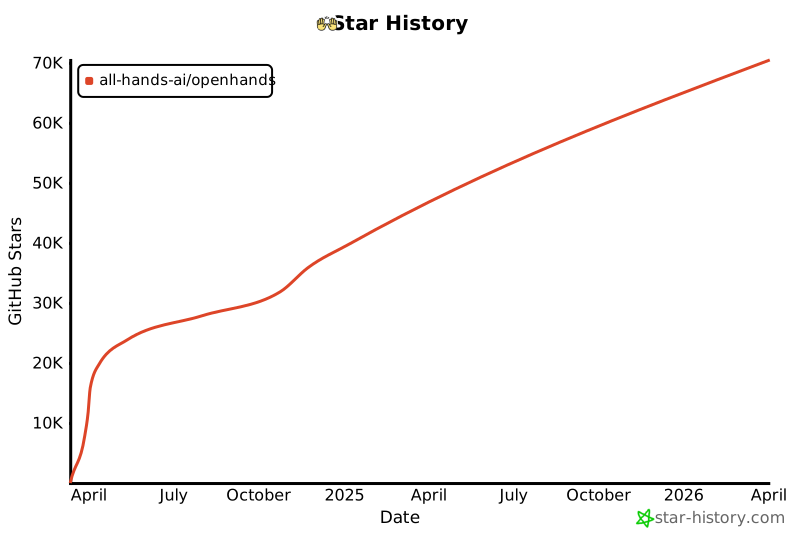](https://star-history.com/#All-Hands-AI/OpenHands&Date)
## 🛠️ Construit Avec {#built-with}
OpenHands est construit en utilisant une combinaison de cadres et de bibliothèques puissants, offrant une base robuste pour son développement. Voici les technologies clés utilisées dans le projet :
Veuillez noter que la sélection de ces technologies est en cours, et que des technologies supplémentaires peuvent être ajoutées ou des existantes supprimées au fur et à mesure de l'évolution du projet. Nous nous efforçons d'adopter les outils les plus adaptés et efficaces pour améliorer les capacités d'OpenHands.
## 📜 Licence {#license}
Distribué sous la licence MIT. Voir [notre licence](https://github.com/All-Hands-AI/OpenHands/blob/main/LICENSE) pour plus d'informations.
Cet agent implémente l'idée CodeAct ([article](https://arxiv.org/abs/2402.01030), [tweet](https://twitter.com/xingyaow_/status/1754556835703751087)) qui consolide les **act**ions des agents LLM en un espace d'action **code** unifié pour à la fois la _simplicité_ et la _performance_ (voir article pour plus de détails).
L'idée conceptuelle est illustrée ci-dessous. À chaque tour, l'agent peut :
1.**Converse** : Communiquer avec les humains en langage naturel pour demander des clarifications, des confirmations, etc.
2.**CodeAct** : Choisir d'accomplir la tâche en exécutant du code
- Exécuter toute commande `bash` Linux valide
- Exécuter tout code `Python` valide avec [un interpréteur Python interactif](https://ipython.org/). Cela est simulé à travers la commande `bash`, voir le système de plugin ci-dessous pour plus de détails.
Pour rendre l'agent CodeAct plus puissant avec seulement l'accès à l'espace d'action `bash`, l'agent CodeAct exploite le système de plugins d'OpenHands:
- [Plugin Jupyter](https://github.com/All-Hands-AI/OpenHands/tree/main/openhands/runtime/plugins/jupyter) : pour l'exécution d'IPython via la commande bash
- [Plugin outil agent SWE](https://github.com/All-Hands-AI/OpenHands/tree/main/openhands/runtime/plugins/swe_agent_commands) : Outils de ligne de commande bash puissants pour les tâches de développement logiciel introduits par [swe-agent](https://github.com/princeton-nlp/swe-agent).
| `__init__` | Initialise un agent avec `llm` et une liste de messages `list[Mapping[str, str]]` |
| `step` | Effectue une étape en utilisant l'agent CodeAct. Cela inclut la collecte d'informations sur les étapes précédentes et invite le modèle à exécuter une commande. |
### En cours de réalisation & prochaine étape
[] Support de la navigation sur le web
[] Compléter le workflow pour l'agent CodeAct afin de soumettre des PRs Github
## Agent Planificateur
### Description
L'agent planificateur utilise une stratégie d'incitation spéciale pour créer des plans à long terme pour résoudre les problèmes.
L'agent reçoit ses paires action-observation précédentes, la tâche actuelle, et un indice basé sur la dernière action effectuée à chaque étape.
| `step` | Vérifie si l'étape actuelle est terminée, retourne `AgentFinishAction` si oui. Sinon, crée une incitation de planification et l'envoie au modèle pour inférence, en ajoutant le résultat comme prochaine action. |
Voici un aperçu de haut niveau de l'architecture du système. Le système est divisé en deux composants principaux : le frontend et le backend. Le frontend est responsable de la gestion des interactions avec l'utilisateur et de l'affichage des résultats. Le backend est responsable de la gestion de la logique métier et de l'exécution des agents.
Cet aperçu est simplifié pour montrer les principaux composants et leurs interactions. Pour une vue plus détaillée de l'architecture du backend, consultez la section [Architecture du Backend](#backend-architecture-fr).
# Architecture du Backend {#backend-architecture-fr}
_**Avertissement**: L'architecture du backend est en cours de développement et est sujette à modifications. Le schéma suivant montre l'architecture actuelle du backend basée sur le commit indiqué dans le pied de page du schéma._
2. Ouvrez le fichier généré dans un éditeur PlantUML, par exemple Visual Studio Code avec l'extension PlantUML ou [PlantText](https://www.planttext.com/)
3. Révisez le PUML généré et apportez toutes les modifications nécessaires au schéma (ajoutez les parties manquantes, corrigez les erreurs, améliorez l'agencement).
_py2puml crée le schéma à partir des annotations de type dans le code, donc les annotations de type manquantes ou incorrectes peuvent entraîner un schéma incomplet ou incorrect._
4. Examinez la différence entre le nouveau schéma et le précédent et vérifiez manuellement si les modifications sont correctes.
_Assurez-vous de ne pas supprimer les parties ajoutées manuellement au schéma par le passé et qui sont toujours pertinentes._
5. Ajoutez le hash du commit qui a été utilisé pour générer le schéma dans le pied de page du schéma.
6. Exporte le schéma sous forme de fichiers PNG et SVG et remplacez les schémas existants dans le répertoire `docs/architecture`. Cela peut être fait avec (par exemple [PlantText](https://www.planttext.com/))
Le sandbox par défaut OpenHands est équipé d'une configuration ubuntu minimaliste. Votre cas d'utilisation pourrait nécessiter des logiciels installés par défaut. Cet article vous enseignera comment réaliser cela en utilisant une image docker personnalisée.
## Configuration
Assurez-vous de pouvoir utiliser OpenHands en suivant la documentation [Development.md](https://github.com/All-Hands-AI/OpenHands/blob/main/Development.md).
## Créer Votre Image Docker
Ensuite, vous devez créer votre image docker personnalisée qui doit être basée sur debian/ubuntu. Par exemple, si nous souhaitons que OpenHands ait accès au "node" binaire, nous utiliserions ce Dockerfile:
```bash
# Commencez avec l'image ubuntu la plus récente
FROM ubuntu:latest
# Effectuez les mises à jour nécessaires
RUN apt-get update && apt-get install
# Installez nodejs
RUN apt-get install -y nodejs
```
Ensuite, construisez votre image docker avec le nom de votre choix. Par exemple "image_personnalisée". Pour cela, créez un répertoire et placez le fichier à l'intérieur avec le nom "Dockerfile", puis dans le répertoire exécutez cette commande:
```bash
docker build -t image_personnalisée .
```
Cela produira une nouvelle image appelée ```image_personnalisée``` qui sera disponible dans Docker Engine.
> Remarque: Dans la configuration décrite ici, OpenHands va fonctionner en tant que utilisateur "openhands" à l'intérieur du sandbox et donc tous les packages installés via le Dockerfile seront disponibles pour tous les utilisateurs sur le système, pas seulement root.
>
> L'installation avec apt-get ci-dessus installe nodejs pour tous les utilisateurs.
## Spécifiez votre image personnalisée dans le fichier config.toml
La configuration OpenHands se fait via le fichier de niveau supérieur ```config.toml``` .
Créez un fichier ```config.toml``` dans le répertoire OpenHands et entrez ces contenus:
> Assurez-vous que ```sandbox_base_container_image``` est défini sur le nom de votre image personnalisée précédente.
## Exécution
Exécutez OpenHands en exécutant ```make run``` dans le répertoire racine.
Naviguez vers ```localhost:3001``` et vérifiez si vos dépendances souhaitées sont disponibles.
Dans le cas de l'exemple ci-dessus, la commande ```node -v``` dans la console produit ```v18.19.1```
Félicitations !
## Explication technique
Lorsqu'une image personnalisée est utilisée pour la première fois, elle ne sera pas trouvée et donc elle sera construite (à l'exécution ultérieure, l'image construite sera trouvée et renvoyée).
L'image personnalisée est construite avec [_build_sandbox_image()](https://github.com/All-Hands-AI/OpenHands/blob/main/openhands/runtime/docker/image_agnostic_util.py#L29), qui crée un fichier docker en utilisant votre image personnalisée comme base et configure ensuite l'environnement pour OpenHands, comme ceci:
> Remarque: Le nom de l'image est modifié via [_get_new_image_name()](https://github.com/All-Hands-AI/OpenHands/blob/main/openhands/runtime/docker/image_agnostic_util.py#L63) et c'est ce nom modifié qui sera recherché lors des exécutions ultérieures.
## Dépannage / Erreurs
### Erreur: ```useradd: UID 1000 est non unique```
Si vous voyez cette erreur dans la sortie de la console, il s'agit du fait que OpenHands essaie de créer le utilisateur openhands dans le sandbox avec un ID d'utilisateur de 1000, cependant cet ID d'utilisateur est déjà utilisé dans l'image (pour une raison inconnue). Pour résoudre ce problème, changez la valeur du champ sandbox_user_id dans le fichier config.toml en une valeur différente:
Si vous voyez un message d'erreur indiquant que le port est utilisé ou indisponible, essayez de supprimer toutes les containers docker en cours d'exécution (exécutez `docker ps` et `docker rm` des containers concernés) puis ré-exécutez ```make run```
## Discuter
Pour d'autres problèmes ou questions rejoignez le [Slack](https://join.slack.com/t/opendevin/shared_invite/zt-2oikve2hu-UDxHeo8nsE69y6T7yFX_BA) ou le [Discord](https://discord.gg/ESHStjSjD4) et demandez!
Lorsque vous utilisez OpenHands, vous rencontrerez sans aucun doute des cas où les choses fonctionnent bien et d'autres où elles ne fonctionnent pas. Nous vous encourageons à fournir des commentaires lorsque vous utilisez OpenHands pour aider l'équipe de développement et, peut-être plus important encore, créer un corpus ouvert d'exemples de formation pour les agents de codage -- Partagez-OpenHands !
## 📝 Comment Fournir des Commentaires
Fournir des commentaires est simple ! Lorsque vous utilisez OpenHands, vous pouvez appuyer sur le bouton de pouce vers le haut ou vers le bas à n'importe quel moment de votre interaction. Vous serez invité à fournir votre adresse email (par exemple, afin que nous puissions vous contacter si nous voulons poser des questions de suivi), et vous pouvez choisir si vous souhaitez fournir des commentaires publiquement ou en privé.
* Les données **publiques** seront distribuées sous la licence MIT, comme OpenHands lui-même, et pourront être utilisées par la communauté pour former et tester des modèles. Évidemment, les commentaires que vous pouvez rendre publics seront plus précieux pour la communauté dans son ensemble, donc lorsque vous ne traitez pas d'informations sensibles, nous vous encourageons à choisir cette option !
* Les données **privées** ne seront partagées qu'avec l'équipe OpenHands dans le but d'améliorer OpenHands.
OpenHands est un **ingénieur logiciel IA autonome** capable d'exécuter des tâches d'ingénierie complexes et de collaborer activement avec les utilisateurs sur des projets de développement logiciel.
Ce projet est entièrement open-source, vous pouvez donc l'utiliser et le modifier comme bon vous semble.
:::tip
Explorez le code source d'OpenHands sur [GitHub](https://github.com/All-Hands-AI/OpenHands) ou rejoignez l'une de nos communautés !
La manière la plus simple d'exécuter OpenHands est à l'intérieur d'un conteneur Docker. Il fonctionne mieux avec la version la plus récente de Docker, `26.0.0`.
Vous devez utiliser Linux, Mac OS ou WSL sur Windows.
Pour démarrer OpenHands dans un conteneur docker, exécutez les commandes suivantes dans votre terminal :
:::warning
Lorsque vous exécutez la commande suivante, les fichiers dans `./workspace` peuvent être modifiés ou supprimés.
:::
```bash
WORKSPACE_BASE=$(pwd)/workspace
docker run -it \
--pull=always \
-e SANDBOX_USER_ID=$(id -u) \
-e WORKSPACE_MOUNT_PATH=$WORKSPACE_BASE \
-v $WORKSPACE_BASE:/opt/workspace_base \
-v /var/run/docker.sock:/var/run/docker.sock \
-p 3000:3000 \
--add-host host.docker.internal:host-gateway \
--name openhands-app-$(date +%Y%m%d%H%M%S) \
ghcr.io/all-hands-ai/openhands:main
```
Vous trouverez OpenHands fonctionnant à l'adresse [http://localhost:3000](http://localhost:3000) avec accès à `./workspace`. Pour qu'OpenHands fonctionne sur votre code, placez-le dans `./workspace`.
OpenHands n'aura accès qu'à ce dossier de workspace. Le reste de votre système ne sera pas affecté car il s'exécute dans un bac à sable sécurisé de docker.
:::tip
Si vous souhaitez utiliser la version **(instable !)** la plus récente, vous pouvez utiliser `ghcr.io/all-hands-ai/openhands:main` comme image (dernière ligne).
:::
Pour le workflow de développement, consultez [Development.md](https://github.com/All-Hands-AI/OpenHands/blob/main/Development.md).
Avez-vous des problèmes ? Consultez notre [Guide de dépannage](https://docs.all-hands.dev/modules/usage/troubleshooting).
:::warning
OpenHands est actuellement en cours de développement, mais vous pouvez déjà exécuter la version alpha pour voir le système de bout en bout en action.
OpenHands utilise LiteLLM pour les appels de complétion. Vous pouvez trouver leur documentation sur Azure [ici](https://docs.litellm.ai/docs/providers/azure)
### Configurations openai Azure
Lors de l'exécution de l'image Docker OpenHands, vous devrez définir les variables d'environnement suivantes en utilisant `-e` :
```
LLM_BASE_URL="<azure-api-base-url>" # e.g. "https://openai-gpt-4-test-v-1.openai.azure.com/"
LLM_API_KEY="<azure-api-key>"
LLM_MODEL="azure/<your-gpt-deployment-name>"
LLM_API_VERSION = "<api-version>" # e.g. "2024-02-15-preview"
```
:::note
Vous pouvez trouver le nom de votre déploiement ChatGPT sur la page des déploiements sur Azure. Par défaut ou initialement, il pourrait être le même que le nom du modèle de chat (par exemple 'GPT4-1106-preview'), mais il n'est pas obligé de l'être. Exécutez OpenHands, et une fois chargé dans le navigateur, allez dans Paramètres et définissez le modèle comme suit : "azure/<your-actual-gpt-deployment-name>". Si ce n'est pas dans la liste, entrez votre propre texte et enregistrez-le.
:::
## Embeddings
OpenHands utilise llama-index pour les embeddings. Vous pouvez trouver leur documentation sur Azure [ici](https://docs.llamaindex.ai/en/stable/api_reference/embeddings/azure_openai/)
### Configurations openai Azure
Le modèle utilisé pour les embeddings Azure OpenAI est "text-embedding-ada-002".
Vous avez besoin du nom de déploiement correct pour ce modèle dans votre compte Azure.
Lors de l'exécution d'OpenHands dans Docker, définissez les variables d'environnement suivantes en utilisant `-e` :
```
LLM_EMBEDDING_MODEL="azureopenai"
LLM_EMBEDDING_DEPLOYMENT_NAME = "<your-embedding-deployment-name>" # e.g. "TextEmbedding...<etc>"
LLM_API_VERSION = "<api-version>" # e.g. "2024-02-15-preview"
OpenHands utilise LiteLLM pour les appels de complétion. Les ressources suivantes sont pertinentes pour utiliser OpenHands avec les LLMs de Google :
- [Gemini - Google AI Studio](https://docs.litellm.ai/docs/providers/gemini)
- [VertexAI - Google Cloud Platform](https://docs.litellm.ai/docs/providers/vertex)
### Configurations de Gemini - Google AI Studio
Pour utiliser Gemini via Google AI Studio lors de l'exécution de l'image Docker d'OpenHands, vous devez définir les variables d'environnement suivantes en utilisant `-e` :
```
GEMINI_API_KEY="<votre-cle-api-google>"
LLM_MODEL="gemini/gemini-1.5-pro"
```
### Configurations de Vertex AI - Google Cloud Platform
Pour utiliser Vertex AI via Google Cloud Platform lors de l'exécution de l'image Docker d'OpenHands, vous devez définir les variables d'environnement suivantes en utilisant `-e` :
OpenHands émettra de nombreuses invitations au LLM que vous configurez. La plupart de ces LLM coûtent de l'argent -- assurez-vous de définir des limites de dépenses et de surveiller l'utilisation.
:::
La variable d'environnement `LLM_MODEL` contrôle le modèle utilisé dans les interactions programmatiques.
Mais en utilisant l'interface utilisateur OpenHands, vous devrez choisir votre modèle dans la fenêtre des paramètres (la roue dentée en bas à gauche).
Les variables d'environnement suivantes peuvent être nécessaires pour certains LLM :
-`LLM_API_KEY`
-`LLM_BASE_URL`
-`LLM_EMBEDDING_MODEL`
-`LLM_EMBEDDING_DEPLOYMENT_NAME`
-`LLM_API_VERSION`
Nous avons quelques guides pour exécuter OpenHands avec des fournisseurs de modèles spécifiques :
- [ollama](llms/local-llms)
- [Azure](llms/azure-llms)
Si vous utilisez un autre fournisseur, nous vous encourageons à ouvrir une PR pour partager votre configuration !
## Remarque sur les modèles alternatifs
Les meilleurs modèles sont GPT-4 et Claude 3. Les modèles locaux et open source actuels ne sont pas aussi puissants.
Lors de l'utilisation d'un modèle alternatif, vous pouvez constater des temps d'attente prolongés entre les messages,
des réponses de mauvaise qualité ou des erreurs sur des JSON mal formés. OpenHands
ne peut être aussi puissant que les modèles qui le pilotent -- heureusement, les membres de notre équipe travaillent activement à la construction de meilleurs modèles open source !
## Réessais d'API et limites de taux
Certains LLM ont des limites de taux et peuvent nécessiter des réessais. OpenHands réessaiera automatiquement les demandes s'il reçoit une erreur 429 ou une erreur de connexion API.
Vous pouvez définir les variables d'environnement `LLM_NUM_RETRIES`, `LLM_RETRY_MIN_WAIT`, `LLM_RETRY_MAX_WAIT` pour contrôler le nombre de réessais et le temps entre les réessais.
Par défaut, `LLM_NUM_RETRIES` est 8 et `LLM_RETRY_MIN_WAIT`, `LLM_RETRY_MAX_WAIT` sont respectivement de 15 secondes et 120 secondes.
Assurez-vous que le serveur Ollama est en cours d'exécution.
Pour des instructions détaillées de démarrage, consultez [ici](https://github.com/ollama/ollama)
Ce guide suppose que vous avez démarré ollama avec `ollama serve`. Si vous exécutez ollama différemment (par exemple, à l'intérieur de docker), les instructions pourraient devoir être modifiées. Veuillez noter que si vous utilisez WSL, la configuration par défaut de ollama bloque les requêtes des conteneurs docker. Voir [ici](#configuring-ollama-service-fr).
## Télécharger des modèles
Les noms des modèles Ollama peuvent être trouvés [ici](https://ollama.com/library). Pour un petit exemple, vous pouvez utiliser
le modèle `codellama:7b`. Des modèles plus grands offriront généralement de meilleures performances.
```bash
ollama pull codellama:7b
```
vous pouvez vérifier quels modèles vous avez téléchargés de cette manière :
```bash
~$ ollama list
NAME ID SIZE MODIFIED
codellama:7b 8fdf8f752f6e 3.8 GB 6 weeks ago
mistral:7b-instruct-v0.2-q4_K_M eb14864c7427 4.4 GB 2 weeks ago
starcoder2:latest f67ae0f64584 1.7 GB 19 hours ago
```
## Démarrer OpenHands
### Docker
Utilisez les instructions [ici](../intro) pour démarrer OpenHands en utilisant Docker.
Mais lors de l'exécution de `docker run`, vous devrez ajouter quelques arguments supplémentaires :
Vous devriez maintenant pouvoir vous connecter à `http://localhost:3000/`
### Compiler à partir des sources
Utilisez les instructions dans [Development.md](https://github.com/All-Hands-AI/OpenHands/blob/main/Development.md) pour compiler OpenHands.
Assurez-vous que `config.toml` soit présent en exécutant `make setup-config` qui en créera un pour vous. Dans `config.toml`, saisissez les éléments suivants :
```
LLM_MODEL="ollama/codellama:7b"
LLM_API_KEY="ollama"
LLM_EMBEDDING_MODEL="local"
LLM_BASE_URL="http://localhost:11434"
WORKSPACE_BASE="./workspace"
WORKSPACE_DIR="$(pwd)/workspace"
```
Remplacez `LLM_MODEL` par celui de votre choix si nécessaire.
Fini ! Vous pouvez maintenant démarrer OpenHands avec : `make run` sans Docker. Vous devriez maintenant pouvoir vous connecter à `http://localhost:3000/`
## Sélection de votre modèle
Dans l'interface OpenHands, cliquez sur l'icône des paramètres en bas à gauche.
Ensuite, dans l'entrée `Model`, saisissez `ollama/codellama:7b`, ou le nom du modèle que vous avez téléchargé précédemment.
S'il n'apparaît pas dans un menu déroulant, ce n'est pas grave, tapez-le simplement. Cliquez sur Enregistrer lorsque vous avez terminé.
Et maintenant, vous êtes prêt à démarrer !
## Configuration du service ollama (WSL){#configuring-ollama-service-fr}
La configuration par défaut pour ollama sous WSL ne sert que localhost. Cela signifie que vous ne pouvez pas l'atteindre depuis un conteneur docker, par exemple, il ne fonctionnera pas avec OpenHands. Testons d'abord que ollama est en cours d'exécution correctement.
```bash
ollama list # obtenir la liste des modèles installés
Maintenant faisons en sorte que cela fonctionne. Modifiez /etc/systemd/system/ollama.service avec les privilèges sudo. (Le chemin peut varier selon la distribution Linux)
```bash
sudo vi /etc/systemd/system/ollama.service
```
ou
```bash
sudo nano /etc/systemd/system/ollama.service
```
Dans la section [Service], ajoutez ces lignes
```
Environment="OLLAMA_HOST=0.0.0.0:11434"
Environment="OLLAMA_ORIGINS=*"
```
Ensuite, sauvegardez, rechargez la configuration et redémarrez le service.
```bash
sudo systemctl daemon-reload
sudo systemctl restart ollama
```
Enfin, testez que ollama est accessible depuis le conteneur
```bash
ollama list # obtenir la liste des modèles installés
docker ps # obtenir la liste des conteneurs docker en cours d'exécution, pour un test le plus précis choisissez le conteneur de sandbox OpenHands.
Il existe certains messages d'erreur qui sont souvent signalés par les utilisateurs.
Nous essaierons de rendre le processus d'installation plus facile et ces messages d'erreur
mieux à l'avenir. Mais pour l'instant, vous pouvez rechercher votre message d'erreur ci-dessous et voir s'il existe des solutions de contournement.
Pour chacun de ces messages d'erreur, **il existe un problème existant**. Veuillez ne pas
ouvrir un nouveau problème - commentez simplement dessus.
Si vous trouvez plus d'informations ou une solution de contournement pour l'un de ces problèmes, veuillez ouvrir un *PR* pour ajouter des détails à ce fichier.
:::tip
Si vous utilisez Windows et que vous rencontrez des problèmes, consultez notre [guide pour les utilisateurs de Windows (WSL)](troubleshooting/windows).
Erreur lors de la création du contrôleur. Veuillez vérifier que Docker est en cours d'exécution et visitez `https://docs.all-hands.dev/modules/usage/troubleshooting` pour plus d'informations sur le débogage.
```
```bash
docker.errors.DockerException: Erreur lors de la récupération de la version de l'API du serveur : ('Connection aborted.', FileNotFoundError(2, 'Aucun fichier ou répertoire de ce type'))
```
### Détails
OpenHands utilise un conteneur Docker pour effectuer son travail en toute sécurité, sans risquer de briser votre machine.
### Solutions de contournement
* Exécutez `docker ps` pour vous assurer que docker est en cours d'exécution
* Assurez-vous que vous n'avez pas besoin de `sudo` pour exécuter docker [voir ici](https://www.baeldung.com/linux/docker-run-without-sudo)
* Si vous êtes sur un Mac, vérifiez les [exigences en matière d'autorisations](https://docs.docker.com/desktop/mac/permission-requirements/) et envisagez particulièrement d'activer l'option `Allow the default Docker socket to be used` sous `Settings > Advanced` dans Docker Desktop.
* De plus, mettez à jour Docker vers la dernière version sous `Check for Updates`
OpenHands ne supporte Windows que via [WSL](https://learn.microsoft.com/en-us/windows/wsl/install).
Veuillez vous assurer de lancer toutes les commandes à l'intérieur de votre terminal WSL.
## Dépannage
### Erreur : 'docker' n'a pas pu être trouvé dans cette distribution WSL 2.
Si vous utilisez Docker Desktop, assurez-vous de le démarrer avant d'exécuter toute commande docker depuis l'intérieur de WSL.
Docker doit également avoir l'option d'intégration WSL activée.
### Recommandation : Ne pas exécuter en tant qu'utilisateur root
Pour des raisons de sécurité, il est fortement recommandé de ne pas exécuter OpenHands en tant qu'utilisateur root, mais en tant qu'utilisateur avec un UID non nul.
De plus, les sandboxes persistants ne seront pas pris en charge lors de l'exécution en tant que root et un message approprié pourrait apparaître lors du démarrage d'OpenHands.
Références :
* [Pourquoi il est mauvais de se connecter en tant que root](https://askubuntu.com/questions/16178/why-is-it-bad-to-log-in-as-root)
* [Définir l'utilisateur par défaut dans WSL](https://www.tenforums.com/tutorials/128152-set-default-user-windows-subsystem-linux-distro-windows-10-a.html#option2)
Astuce pour la 2e référence : pour les utilisateurs d'Ubuntu, la commande pourrait en fait être "ubuntupreview" au lieu de "ubuntu".
### Échec de la création de l'utilisateur openhands
Si vous rencontrez l'erreur suivante lors de l'installation :
```sh
Exception: Failed to create openhands user in sandbox: 'useradd: UID 0 is not unique'
```
Vous pouvez la résoudre en exécutant :
```sh
exportSANDBOX_USER_ID=1000
```
### Installation de Poetry
* Si vous rencontrez des problèmes pour exécuter Poetry même après l'avoir installé pendant le processus de construction, il peut être nécessaire d'ajouter son chemin binaire à votre environnement :
```sh
exportPATH="$HOME/.local/bin:$PATH"
```
* Si `make build` s'arrête avec une erreur telle que :
```sh
ModuleNotFoundError: no module named <module-name>
```
Cela pourrait être un problème avec le cache de Poetry.
Essayez d'exécuter ces 2 commandes l'une après l'autre :
```sh
rm -r ~/.cache/pypoetry
make build
```
### L'objet NoneType n'a pas d'attribut 'request'
Si vous rencontrez des problèmes liés au réseau, tels que `NoneType object has no attribute 'request'` lors de l'exécution de `make run`, il peut être nécessaire de configurer vos paramètres réseau WSL2. Suivez ces étapes :
* Ouvrez ou créez le fichier `.wslconfig` situé à `C:\Users\%username%\.wslconfig` sur votre machine hôte Windows.
* Ajoutez la configuration suivante au fichier `.wslconfig` :
```sh
[wsl2]
networkingMode=mirrored
localhostForwarding=true
```
* Enregistrez le fichier `.wslconfig`.
* Redémarrez WSL2 complètement en quittant toute instance WSL2 en cours d'exécution et en exécutant la commande `wsl --shutdown` dans votre invite de commande ou terminal.
* Après avoir redémarré WSL, essayez d'exécuter `make run` à nouveau.
"description":"The title of the fallback page when the page crashed"
},
"theme.BackToTopButton.buttonAriaLabel":{
"message":"返回顶部",
"description":"The ARIA label for the back to top button"
},
"theme.blog.archive.title":{
"message":"历史博文",
"description":"The page & hero title of the blog archive page"
},
"theme.blog.archive.description":{
"message":"历史博文",
"description":"The page & hero description of the blog archive page"
},
"theme.blog.paginator.navAriaLabel":{
"message":"博文列表分页导航",
"description":"The ARIA label for the blog pagination"
},
"theme.blog.paginator.newerEntries":{
"message":"较新的博文",
"description":"The label used to navigate to the newer blog posts page (previous page)"
},
"theme.blog.paginator.olderEntries":{
"message":"较旧的博文",
"description":"The label used to navigate to the older blog posts page (next page)"
},
"theme.blog.post.paginator.navAriaLabel":{
"message":"博文分页导航",
"description":"The ARIA label for the blog posts pagination"
},
"theme.blog.post.paginator.newerPost":{
"message":"较新一篇",
"description":"The blog post button label to navigate to the newer/previous post"
},
"theme.blog.post.paginator.olderPost":{
"message":"较旧一篇",
"description":"The blog post button label to navigate to the older/next post"
},
"theme.blog.post.plurals":{
"message":"{count} 篇博文",
"description":"Pluralized label for \"{count} posts\". Use as much plural forms (separated by \"|\") as your language support (see https://www.unicode.org/cldr/cldr-aux/charts/34/supplemental/language_plural_rules.html)"
},
"theme.blog.tagTitle":{
"message":"{nPosts} 含有标签「{tagName}」",
"description":"The title of the page for a blog tag"
},
"theme.tags.tagsPageLink":{
"message":"查看所有标签",
"description":"The label of the link targeting the tag list page"
},
"theme.colorToggle.ariaLabel":{
"message":"切换浅色/暗黑模式(当前为{mode})",
"description":"The ARIA label for the navbar color mode toggle"
},
"theme.colorToggle.ariaLabel.mode.dark":{
"message":"暗黑模式",
"description":"The name for the dark color mode"
},
"theme.colorToggle.ariaLabel.mode.light":{
"message":"浅色模式",
"description":"The name for the light color mode"
},
"theme.docs.breadcrumbs.navAriaLabel":{
"message":"页面路径",
"description":"The ARIA label for the breadcrumbs"
"description":"The default description for a category card in the generated index about how many items this category includes"
},
"theme.docs.paginator.navAriaLabel":{
"message":"文件选项卡",
"description":"The ARIA label for the docs pagination"
},
"theme.docs.paginator.previous":{
"message":"上一页",
"description":"The label used to navigate to the previous doc"
},
"theme.docs.paginator.next":{
"message":"下一页",
"description":"The label used to navigate to the next doc"
},
"theme.docs.tagDocListPageTitle.nDocsTagged":{
"message":"{count} 篇文档带有标签",
"description":"Pluralized label for \"{count} docs tagged\". Use as much plural forms (separated by \"|\") as your language support (see https://www.unicode.org/cldr/cldr-aux/charts/34/supplemental/language_plural_rules.html)"
},
"theme.docs.tagDocListPageTitle":{
"message":"{nDocsTagged}「{tagName}」",
"description":"The title of the page for a docs tag"
"description":"The ARIA label to collapse the sidebar category"
},
"theme.NavBar.navAriaLabel":{
"message":"主导航",
"description":"The ARIA label for the main navigation"
},
"theme.navbar.mobileLanguageDropdown.label":{
"message":"选择语言",
"description":"The label for the mobile language switcher dropdown"
},
"theme.NotFound.p1":{
"message":"我们找不到您要找的页面。",
"description":"The first paragraph of the 404 page"
},
"theme.NotFound.p2":{
"message":"请联系原始链接来源网站的所有者,并告知他们链接已损坏。",
"description":"The 2nd paragraph of the 404 page"
},
"theme.TOCCollapsible.toggleButtonLabel":{
"message":"本页总览",
"description":"The label used by the button on the collapsible TOC component"
},
"theme.blog.post.readMore":{
"message":"阅读更多",
"description":"The label used in blog post item excerpts to link to full blog posts"
},
"theme.blog.post.readMoreLabel":{
"message":"阅读 {title} 的全文",
"description":"The ARIA label for the link to full blog posts from excerpts"
},
"theme.blog.post.readingTime.plurals":{
"message":"阅读需 {readingTime} 分钟",
"description":"Pluralized label for \"{readingTime} min read\". Use as much plural forms (separated by \"|\") as your language support (see https://www.unicode.org/cldr/cldr-aux/charts/34/supplemental/language_plural_rules.html)"
},
"theme.docs.breadcrumbs.home":{
"message":"主页面",
"description":"The ARIA label for the home page in the breadcrumbs"
},
"theme.docs.sidebar.collapseButtonTitle":{
"message":"收起侧边栏",
"description":"The title attribute for collapse button of doc sidebar"
},
"theme.docs.sidebar.collapseButtonAriaLabel":{
"message":"收起侧边栏",
"description":"The title attribute for collapse button of doc sidebar"
},
"theme.docs.sidebar.navAriaLabel":{
"message":"文档侧边栏",
"description":"The ARIA label for the sidebar navigation"
"description":"The label of the back button to return to main menu, inside the mobile navbar sidebar secondary menu (notably used to display the docs sidebar)"
Some files were not shown because too many files have changed in this diff
Show More
Reference in New Issue
Block a user
Blocking a user prevents them from interacting with repositories, such as opening or commenting on pull requests or issues. Learn more about blocking a user.

